Collector Guide • Japanese Sporting Shotguns
Smith & Wesson Model 1000MThe 12-Gauge Magnum with a 30-Inch Barrel
A close look at my Howa-built S&W: its Full-choke barrel, gas action, markings, and care.
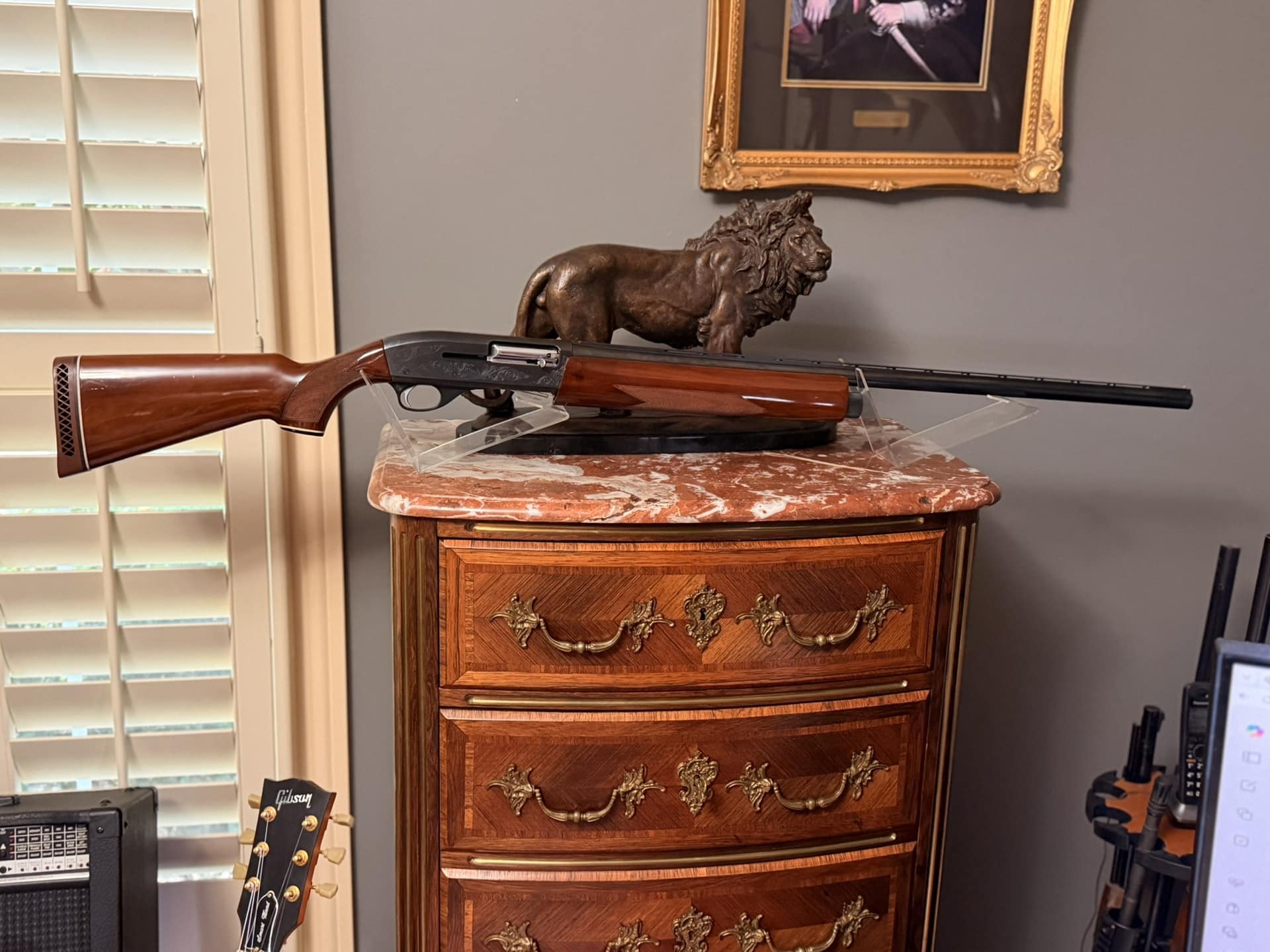
Smith & Wesson is a familiar name on a revolver barrel. On a long, polished sporting shotgun, it still makes some people stop and look. My Model 1000M is a 12-gauge Magnum with a 30-inch barrel, a ventilated rib, and a barrel marked Full. It belongs to a period when a hunting gun could wear glossy walnut, receiver scrollwork, and a bright company medallion without apologizing for any of it.
This Japanese-made Model 1000M belongs to the original Howa-built Model 1000 family. Its Magnum chambering, steel receiver, and gas-operated action give it a distinct place among S&W sporting guns.
For a collector, that is the appeal: a Japanese-made Smith & Wesson shotgun from a chapter of the company’s history many handgun enthusiasts overlook. When I first spotted this shotgun on the wall at Piranha Pistol and Pawn, I thought it was a 28" barrel gun. Shane pointed out that it was a Magnum gun and the forearm was slightly longer, giving the barrel the shorter appearance. I paid $796 OTD and when I got it home and tried to add it to my Winchester stand, I had to raise the height of the upper grips to clear that long forearm.
The Model 1000M at a glance
| Feature | The featured shotgun |
|---|---|
| Model | Smith & Wesson Model 1000M. |
| Gauge and chamber | 12 gauge; barrel marked 3-inch chamber. |
| Barrel | 30 inches; ventilated rib. |
| Choke marking | FULL. |
| Origin | Barrel marked as manufactured in Japan to S&W specifications. |
| Action / receiver | Gas-operated semiautomatic; the period catalog specifies a steel receiver for the Magnum. |
| Furniture | Gloss-finished wood, checkered grip and fore-end, S&W grip-cap medallion, ventilated recoil pad. |
| Serial prefix | FC; see serial numbers and dating. |
S&W’s 1982 catalog lists the 30-inch Full-choke 12-gauge Magnum under order number 34259 and the Modified version under 34289. My gun matches the listed Full-choke configuration. These are catalog order numbers, separate from the receiver serial number. [1]
Where the original Model 1000 fits in S&W history
The Model 1000 family entered S&W’s lineup in 1973. The American Rifleman reviewed it in June 1974, identifying Howa Machinery of Nagoya, Japan, as its developer and manufacturer, with changes contributed by S&W engineers. [2]
The family expanded into different chamberings, target configurations, barrels, and finishes. By the 1982 catalog, S&W offered the 12-gauge Magnum with the 30-inch barrel described here.
Period advertising also shows what S&W wanted a sporting customer to notice. Its 1975 Model 1000 advertisement emphasized wood, finish, balance, and mechanical features alongside the familiar trademark. The shotgun was being presented as part of a broader sporting-goods identity, rather than merely an unfamiliar long gun carrying a handgun maker's name. [3]
For a collector, that identity is part of the appeal. A display of S&W firearms can tell a larger story when it includes a sporting shotgun alongside the revolvers. The change in scale is obvious, but the brand presentation is still recognizable: the lettering, the medallion, and the attention paid to surfaces the owner would see and touch.
Howa’s Model 1000 later appeared under the Mossberg name. The National Mossberg Collectors Association lists those imports for 1985–1987, explaining why both brands appear in later discussions and parts references. [4]
What the M means—and the lookalikes to separate
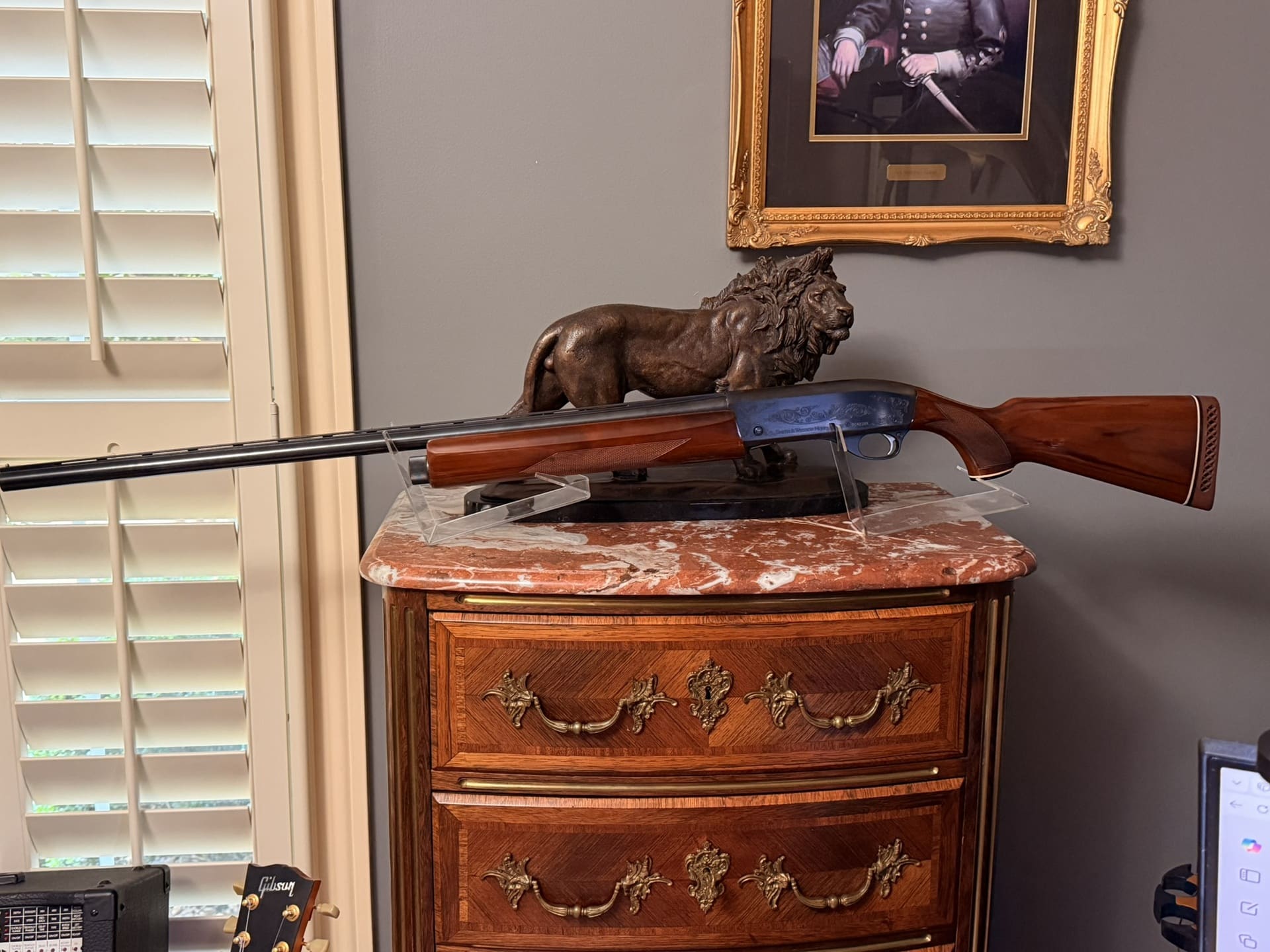
The receiver’s Model 1000M inscription and the barrel’s 3-inch chamber marking identify this as the Magnum configuration. Check both when evaluating a gun advertised as a Magnum.
The original family included lighter, shorter-chambered field guns and specialized target versions. S&W's period specification distinguishes the Magnum's steel receiver from the alloy receiver of the ordinary field gun. Its catalog also lists steel-receiver slug and target models, so receiver material by itself does not identify a Magnum. Read the complete model designation and the actual barrel markings. [1]
The Model 1000 Super 12 has a separate manual in the surviving S&W long-gun documentation index. Identify the variant, gauge, and chambering before ordering parts or choosing operating instructions. [5]
The other trap is much later. S&W's November 2006 announcement introduced a new 1000 Series for the 2007 market, manufactured in Turkey. That announcement concerns a different generation of shotguns. Its specifications, accessory descriptions, and warranty language do not describe the older Japanese Model 1000M. [6]
For useful search results, include Japan, Howa, and Model 1000M. Add the gauge and chamber marking when researching a replacement part.
Reading the markings on my shotgun
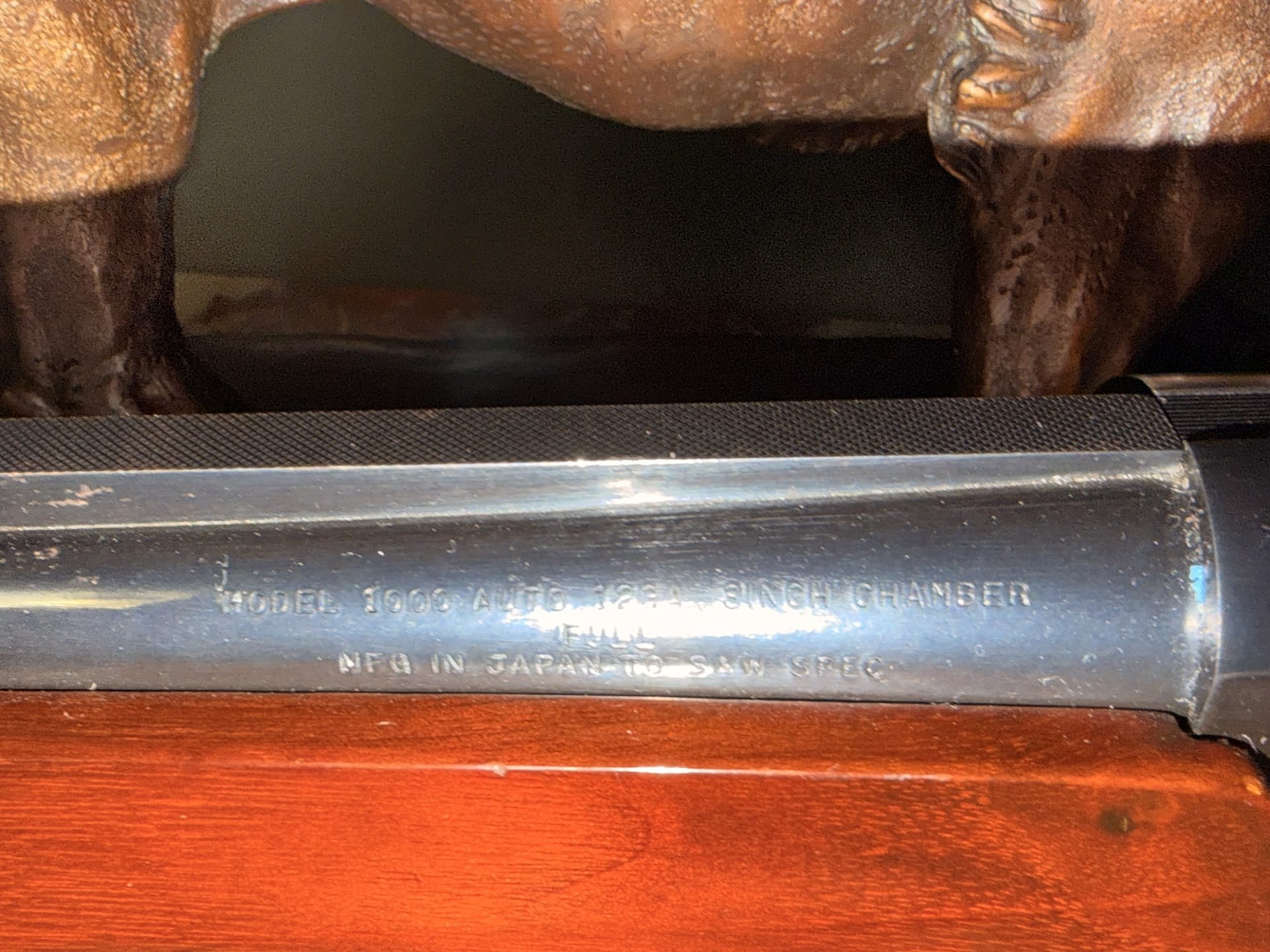
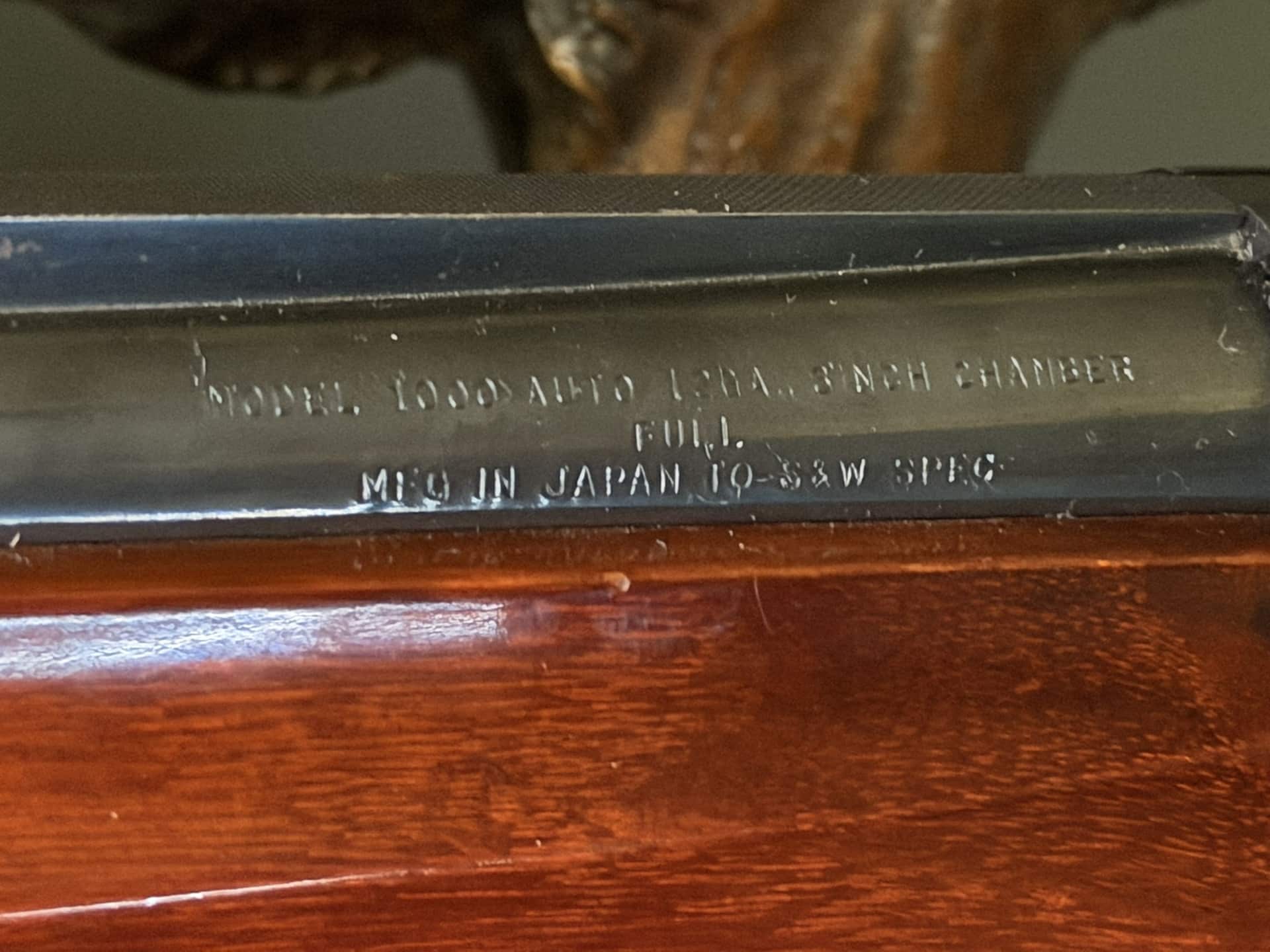
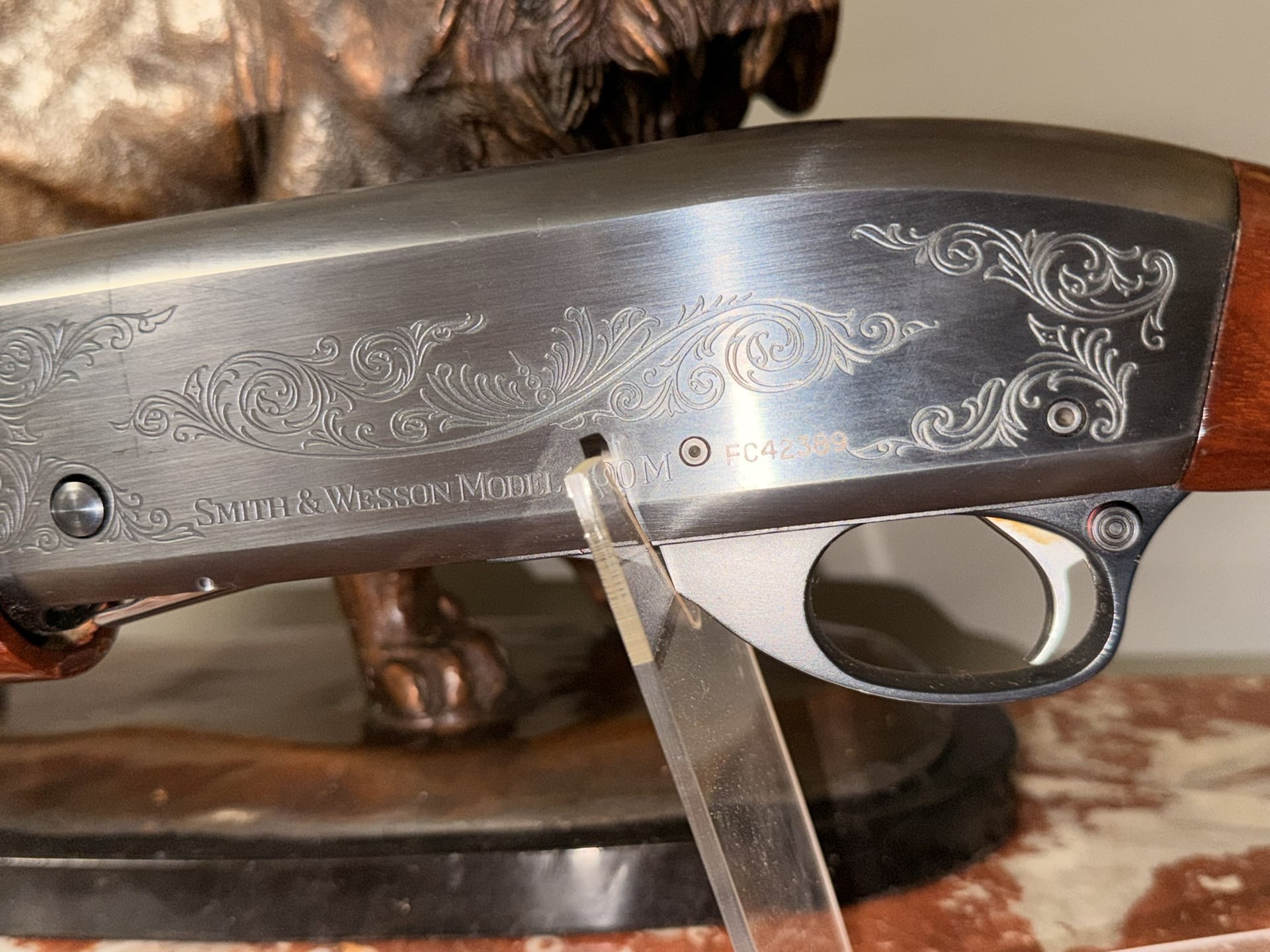
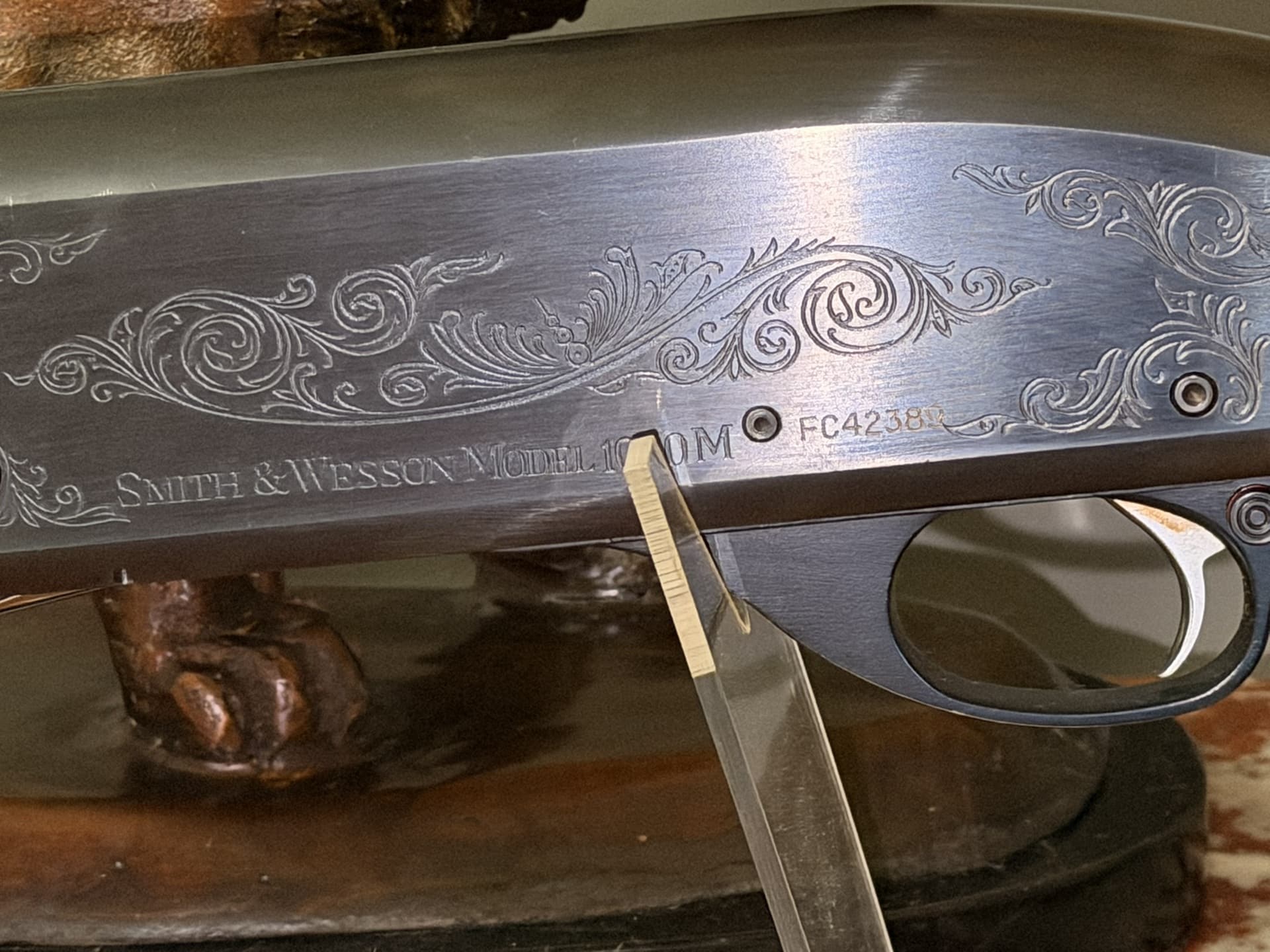
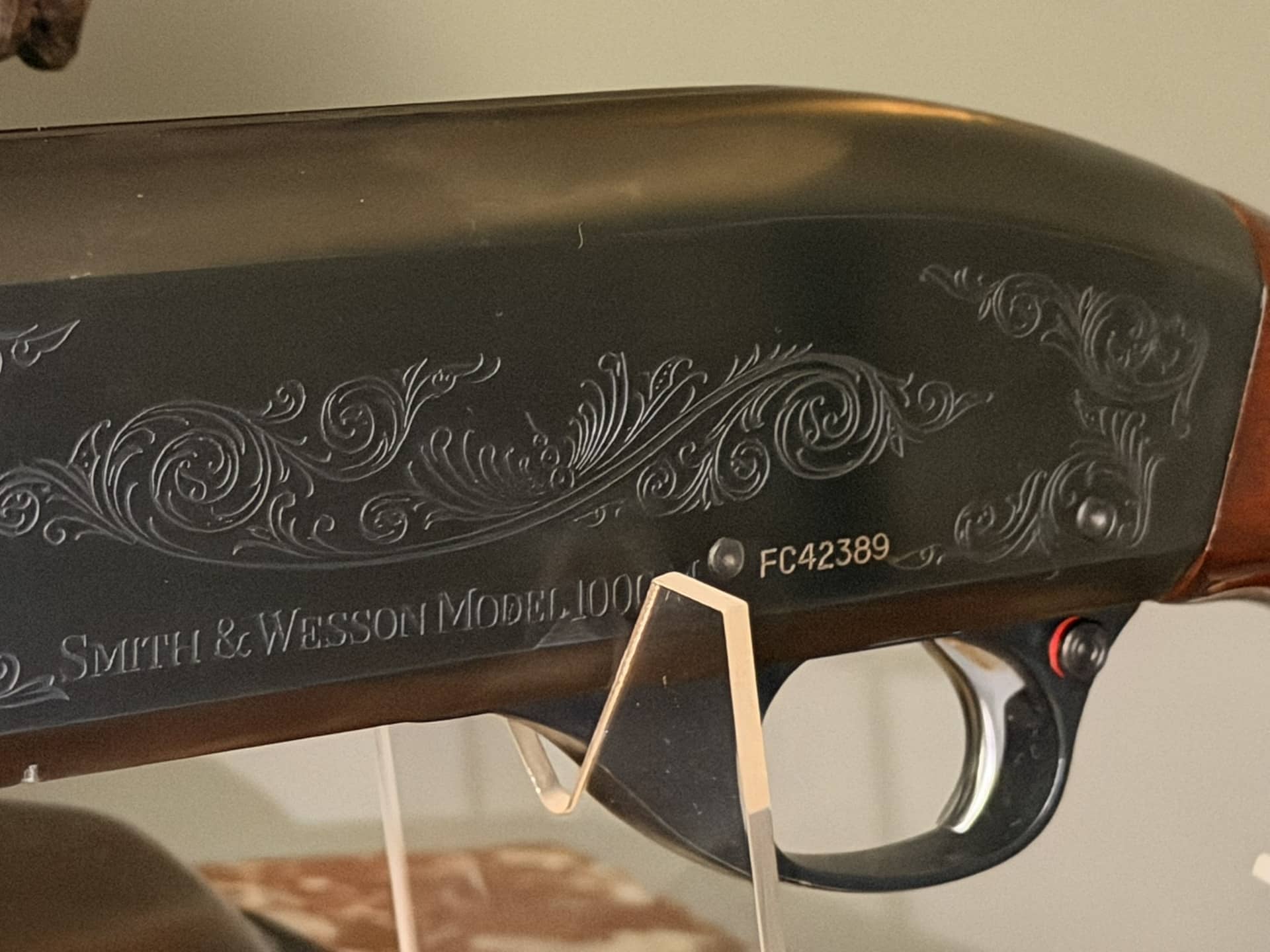
The left receiver carries the model and serial number. The barrel supplies the gauge, chamber length, choke marking, and country of manufacture. Together, those views document the gun’s configuration.
The barrel reads MODEL 1000 AUTO 12 GA. 3 INCH CHAMBER, with FULL beneath it and the Japanese manufacturing statement below. The receiver adds the important M suffix. A collector should not mistake the shorter model wording on the barrel for evidence that the receiver is incorrectly marked. Components can carry different levels of identifying detail.
One photograph catches the polished metal in direct reflection; another gives a clearer reading with the light at a different angle. That is a practical reminder about photographing blued firearms. A pale stripe across a curved surface may be glare rather than finish loss. Conversely, deep blue in a flattering photograph can hide worn edges. I prefer several views before assigning a condition description.
The serial sits on the left side of the receiver, alongside the model inscription and above the trigger area. Record the complete number, including its FC prefix.
Walnut, scrollwork, and the appearance of a sporting gun
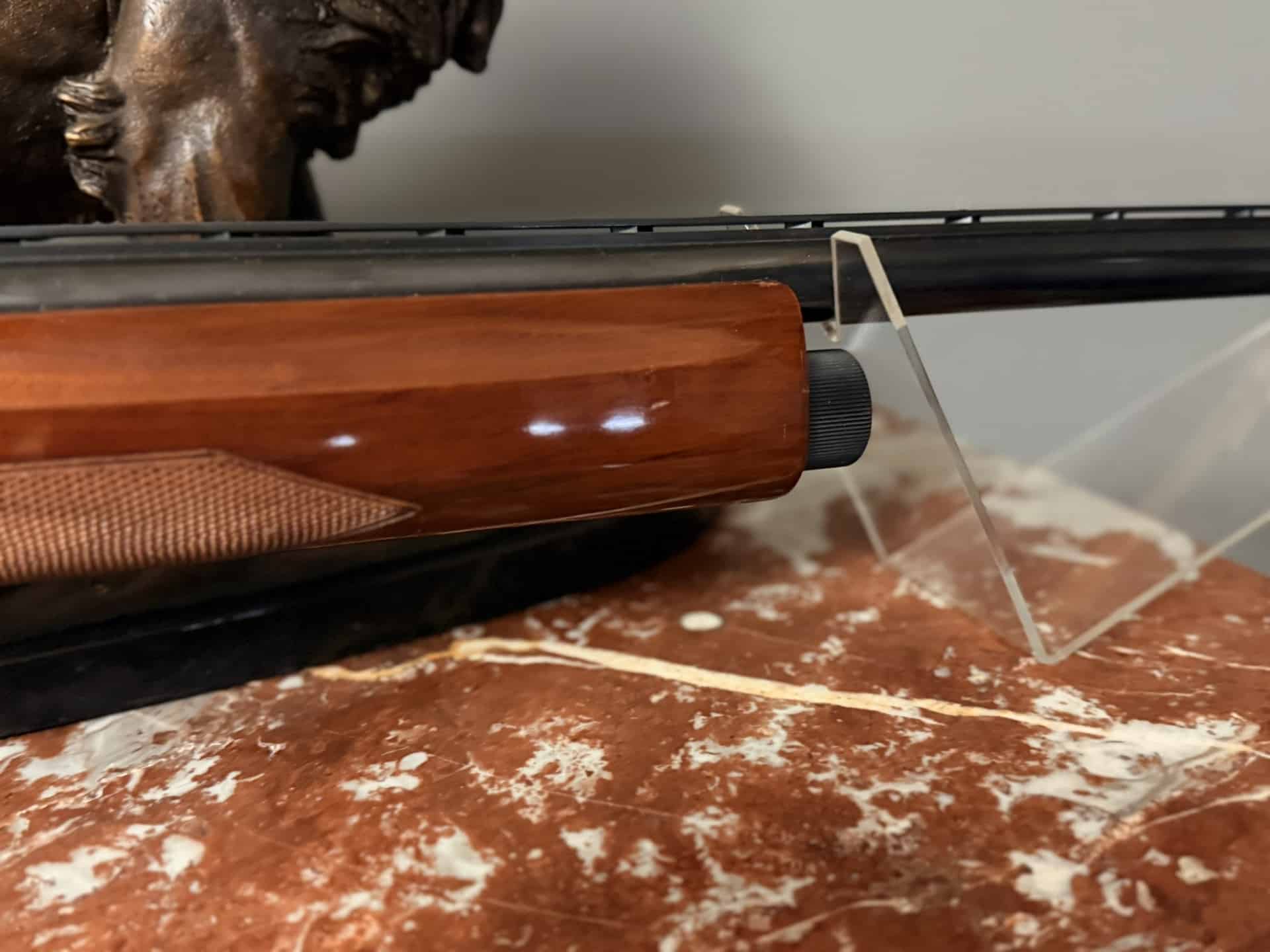
The most immediate impression in these photographs is the contrast between warm wood and dark metal. The fore-end is long and smoothly rounded. Checkered panels interrupt the gloss where the hands meet the gun. At the rear, the pistol grip flows into a broad buttstock, ending in a ventilated recoil pad with a light-colored spacer.
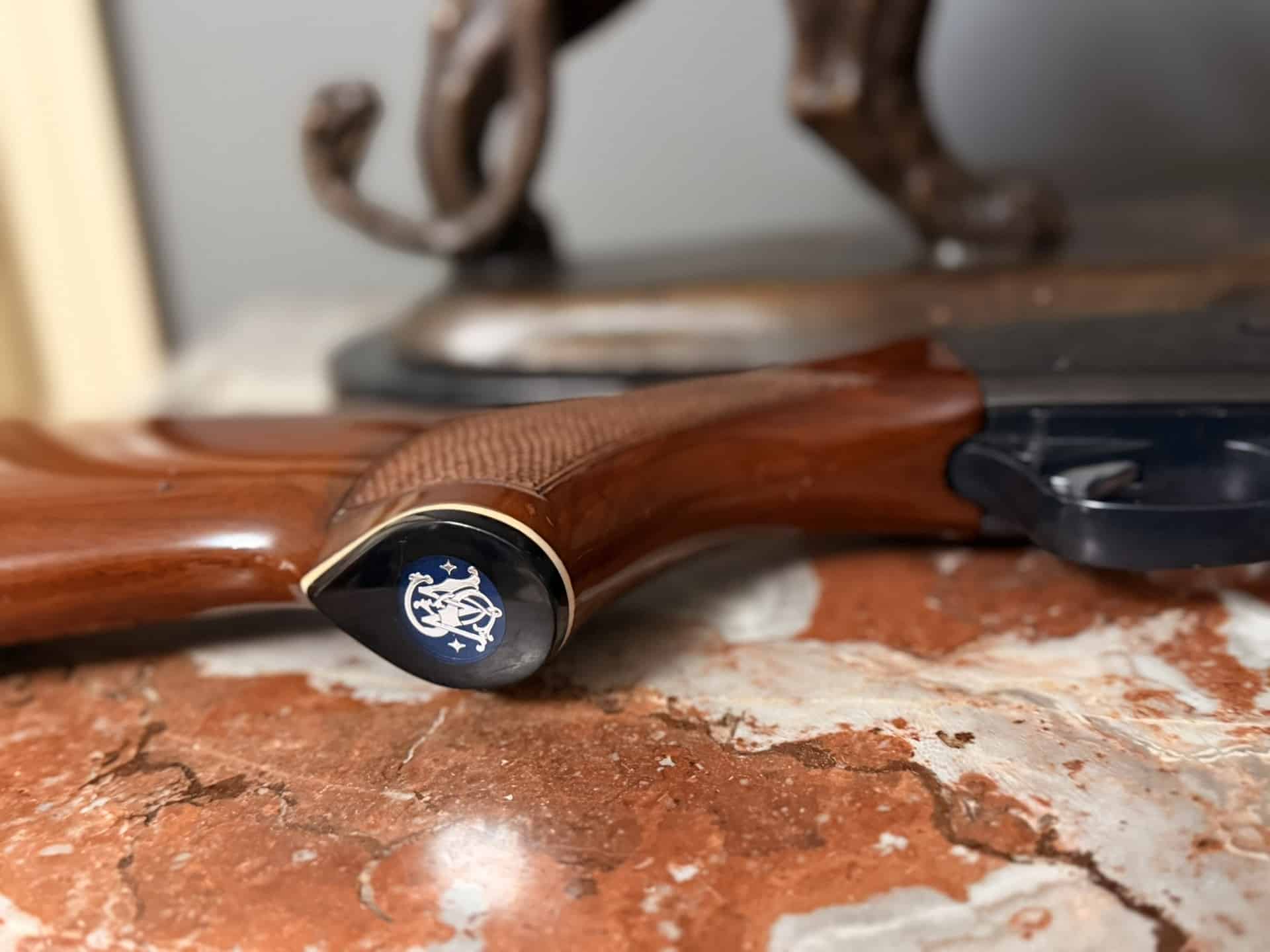
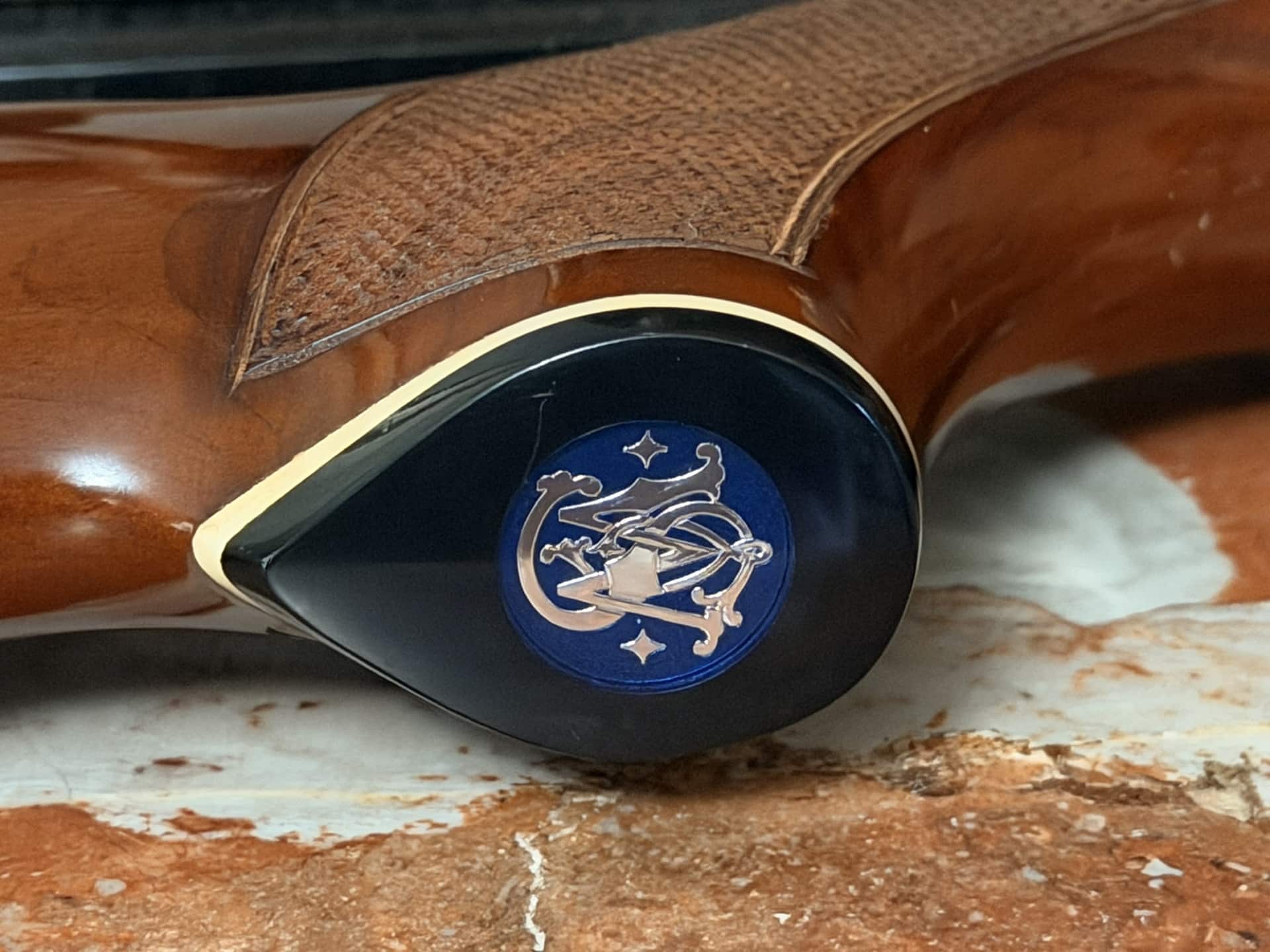
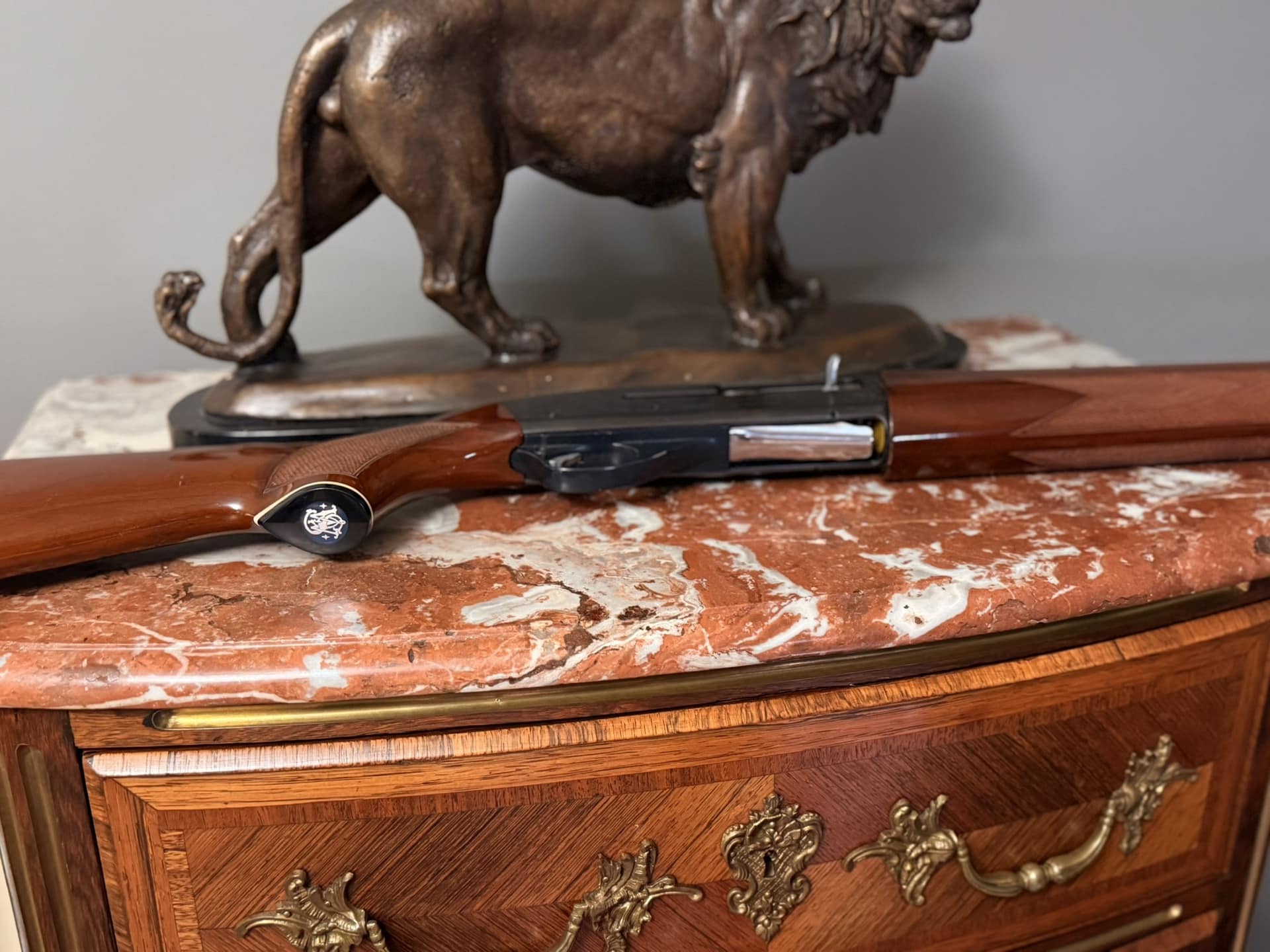
The grip cap deserves its own photograph. A blue inset carries the familiar intertwined S&W emblem in a silver-colored design. The dark cap and pale spacer frame it neatly. It is a small component, but one that does a great deal of visual work: even when the receiver lettering is out of sight, the gun announces its brand.
For my eye, the details work because they belong together. The grip cap, glossy stock, checkering, pad, and receiver decoration share the same traditional sporting vocabulary. None needs to be described as a custom feature to be attractive. A well-preserved ordinary configuration can be more instructive than a heavily altered example with a more dramatic sales description.
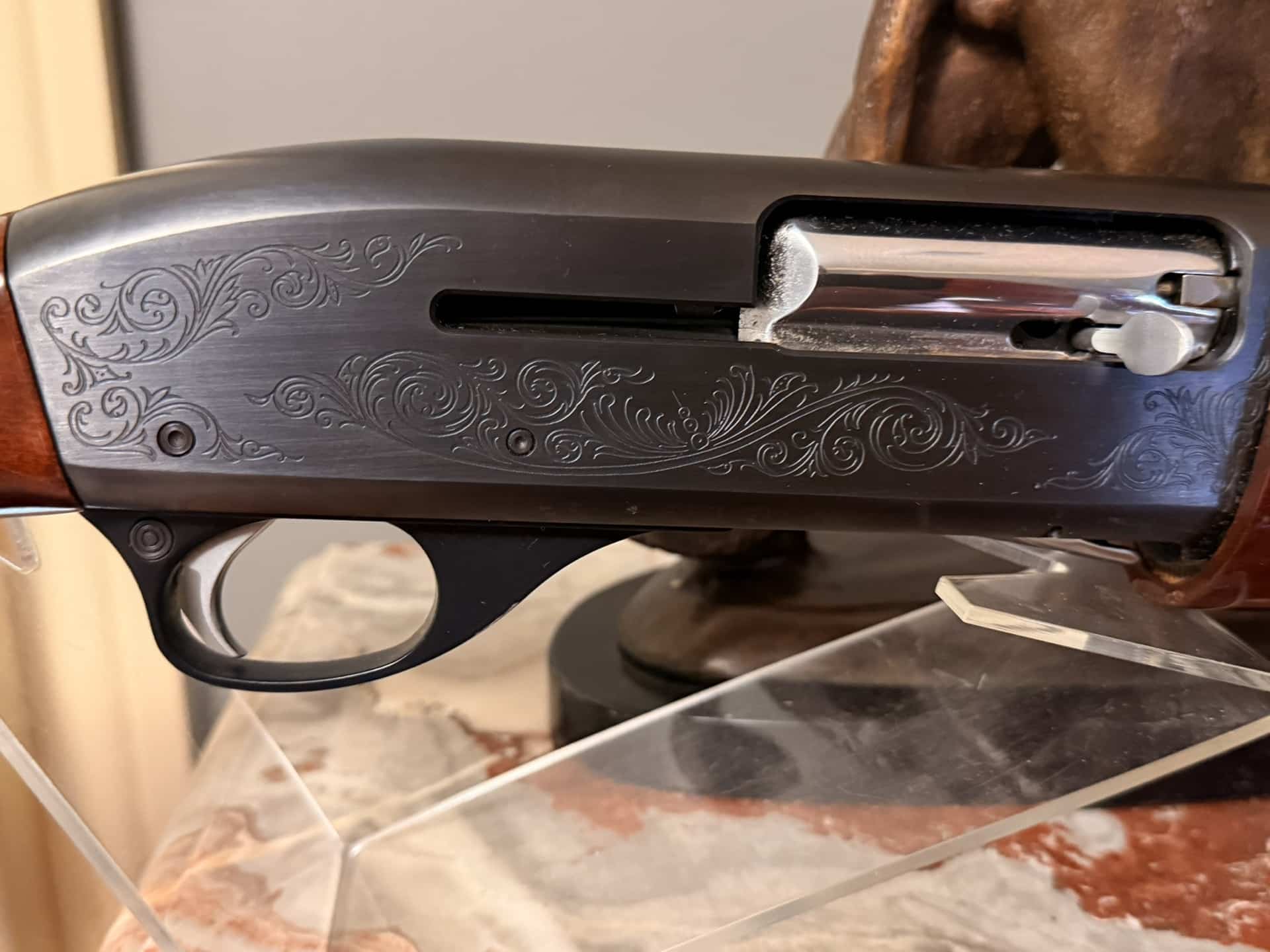
The receiver’s flowing scroll pattern is a factory decorative feature. S&W’s period material describes scroll etching on the Model 1000, which suits the polished blue metal and glossy wood. [3]
When assessing originality, examine wood-to-metal fit, checkering borders, pad fit, and finish around the markings. Refinished wood or a replacement pad can serve a shooter well, but those changes belong in the collector description.
The 30-inch barrel, ventilated rib, and Full choke
Thirty inches gives this shotgun its long, settled appearance. In the full-length view, the barrel extends the line of the receiver and fore-end without a visual break. The rib stands above the barrel on a series of supports, and its upper surface has a glare-reducing texture visible in the closer photographs.
Barrel length influences proportions, movement, and the sighting plane. Choke concerns muzzle constriction and the distribution of shot with a particular load. The two features do different jobs: a longer barrel does not automatically produce a tighter pattern.
Record the actual barrel length and choke inscription, then check for alterations. Shortening a barrel or fitting aftermarket choke tubes can change its constriction. A gunsmith can measure the bore and choke; patterning with suitable ammunition shows how the gun and load perform together.
Rib condition is worth attention as well. Inspect its alignment and supports, the muzzle, and the surface where barrel meets receiver. Damage can be easy to overlook when the wood is especially attractive. On a long-barreled sporting shotgun, the barrel is central to both usefulness and value; it should receive at least as much scrutiny as the stock.
How the gas-operated action works
The Model 1000 uses propellant gas to operate an internal piston beneath the fore-end while the barrel remains stationary. The mechanism unlocks the bolt, extracts and ejects the fired case, and returns forward under spring force. [2]
The distinction from a long-recoil shotgun is important to a collector comparing designs. Two guns can both be semiautomatic and still arrange their moving parts very differently. “Automatic shotgun” in a period sporting description ordinarily means self-loading operation, with a separate trigger pull for each shot. It does not describe continuous fire.
Recoil still depends on gun weight, ammunition, stock fit, the pad, and how the impulse reaches the shooter. A gas action is one part of that combination.
The bright bolt visible through the right-side opening contrasts strongly with the receiver. The photographs also show the operating handle and the underside loading opening. These are useful identification views because they reveal the layout that a simple left-profile photograph omits.
Ammunition: the Magnum barrel has a specific job
S&W’s 1982 catalog specifies 2¾-inch Magnum or 3-inch Magnum shells for the 3-inch-chambered Magnum barrels. Ordinary light target loads fall outside that recommendation and may not cycle reliably. [1]
Chamber fit and cycling reliability are different issues. SAAMI explains that shorter shells can generally be used in longer chambers of the same gauge, while also directing owners to the firearm manufacturer for functioning guidance. The reverse does not follow: a shell longer than the marked chamber can create excessive pressure. A 3-inch marking is not permission to use 3½-inch ammunition. [7]
For modern steel or tungsten loads, confirm compatibility with the specific barrel and choke before use. The Full marking describes choke, not approval for every shot material.
Check the ammunition maker’s specifications and the firearm’s condition together. Chamber length, choke, barrel construction, and operating requirements all matter.
The 1974 NRA review lists three shells in the original Model 1000’s unrestricted magazine, plus one in the chamber. For a Magnum, confirm capacity with its installed limiter and intended shells, and check applicable hunting rules before field use. [2]
The maintenance issue owners should know about
The Model 1000’s piston shock absorber deserves attention as the gun ages. Owners report the original rubber deteriorating into sticky residue or fragments, including on a gun described as unused. Have this component inspected before returning a long-stored shotgun to service. [8]
A Gun Tests gunsmithing account also identifies magazine-tube damage or alignment, fouling, and the rear receiver buffer as potential causes of operating problems. A proper inspection should cover the whole system. [9]
Rubber and other resilient parts age during storage. An unfired gun can still need service, and a clean exterior tells little about the components under the fore-end.
A serviceable replacement should be identified for the exact model and gauge. An ordinary washer that happens to resemble the original is not automatically an equivalent firearm component. The same applies to solvents: a product that is harmless to steel may be unsuitable for an old synthetic part or stock finish. Follow the correct manual and the guidance of the person doing the inspection.
For routine ownership, keep the gun unloaded during inspection and maintenance, with ammunition removed from the work area. Preserve the finish, remove moisture, and use appropriate products in the quantities specified by the manufacturer. More oil is not a substitute for understanding where lubrication belongs.
This is also a good place to draw a line between preservation and modification. Enlarging gas ports, altering engagement surfaces, improvising buffers, or forcing an incompatible barrel onto the gun is not ordinary cleaning. Those actions can change safety, function, and collector value. An older shotgun deserves a diagnosis and suitable service, rather than a speculative alteration intended to make one troublesome load work.
Manuals, spare barrels, and replacement parts
The S&W Forum manual index lists separate documents for the original 12-gauge Model 1000, the 20-gauge version, and the Super 12, plus supplemental autoloading and choke instructions. The attached scans require a forum login. [5]
A manual's title page matters. If the document names later models such as 1012 or 1020, it is not the operating manual for this Japanese Model 1000M. Similarly, a generic exploded diagram may include components for several variants. Read the parts list and its applicability notes before deciding that a drawing answers a particular question.
S&W’s 1982 catalog permits same-gauge 2¾-inch barrels on Magnum receivers and restricts 3-inch barrels to Magnum receivers. Have a gunsmith check the fit and condition of any replacement barrel. [1]
Before ordering a part, confirm its availability, model and gauge, and whether it is new manufacture, old stock, or used. Request a photograph and an accurate description.
Keep service invoices with the gun’s records. Note replaced parts, barrel changes, stock work, and refinishing so the next owner can follow its maintenance history.
Serial numbers and dating
The FC prefix on my gun does not establish a manufacturing year. A dependable lookup requires documented serial ranges for the Model 1000/1000M, so this page leaves the year unassigned.
Catalogs document model offerings; they do not date individual receivers. The 1973 introduction belongs to the original Model 1000 family, while the 1982 catalog documents the Magnum configuration. Neither date proves when my gun was made or whether its components have always been together.
One S&W Forum owner reports buying a 12-gauge 1000M with an FB71xxx serial new in 1982. That is a useful purchase observation, but it supplies no annual serial boundaries and gives no year for an FC-prefixed gun. [10]
S&W revolver tables follow different numbering histories. Keep the K-frame serial-number guide as a revolver reference; it cannot date this Howa-made shotgun.
| Evidence | What it can establish | What it cannot establish alone |
|---|---|---|
| A dated catalog | A configuration was offered in that edition. | The year a particular receiver was made. |
| An original purchase receipt | A documented transaction date, if tied to the gun. | The date all its components were manufactured. |
| An owner's dated recollection | A research lead about one example. | Annual serial boundaries for the entire family. |
| A model-specific factory record | The event actually recorded for the identified firearm. | Events or later changes absent from that record. |
S&W's Historical Foundation explains that surviving shipping records and manufacturing dates are not the same thing, and that serial order does not reliably equal shipping order. Its general letter service should not be assumed to cover every imported long gun. Ask whether records exist for a Howa-made Model 1000M before ordering research. [11]
The practical next step is to assemble clear photographs, the full serial, exact model and barrel markings, and any original paperwork, then ask S&W or the Foundation what research is available for this model. Our factory-letter guide explains the broader distinction between documented shipping facts and a gun's later ownership story.
Examining a Model 1000M before buying
Begin with the model, gauge, chamber, and barrel configuration. For a gun described as “all original,” ask about replaced parts, refinishing, and supporting paperwork.
Look at the metal in even light. Compare broad surfaces with edges and protected areas. Inspect the muzzle, rib, receiver openings, and places where wood meets steel. Strong light can help reveal pitting or an uneven surface beneath a later finish, but photographs alone will not always separate reflections from damage.
On the wood, examine the wrist, the rear of the fore-end, and the fit around the receiver. Look for cracks, repairs, oil-darkened areas, softened checkering, and edges rounded by sanding. A repair may be sound and honestly disclosed. What matters is understanding it before paying for an untouched example.
Check whether the recoil pad follows the stock’s outline and whether the wood has been shortened. A replacement pad changes fit as well as originality. My gun has a ventilated pad and pale spacer.
Mechanical assessment belongs with someone who understands the model. Bore and chamber condition, locking surfaces, safety function, feeding components, and the condition of the buffers all matter. A bolt that can be moved by hand is not a complete function test. If a seller reports a cycling problem, obtain a diagnosis or price the uncertainty honestly.
For a remote purchase, request clear views of both receiver sides, markings, muzzle, rib, stock wrist, pad, and fore-end. These are the photographs that make a listing useful.
Collector interest and value
The Model 1000M appeals to S&W collectors interested in the firm’s sporting guns and to collectors of Japanese-made firearms. Condition, originality, and serviceability drive the value of an individual example.
Compare wood and metal condition, mechanical condition, configuration, and documentation. A sound refinished shooter and a well-preserved gun with its original box belong in different comparison groups.
Use other 12-gauge 1000M Magnums as comparables. Standard 2¾-inch field guns, target models, and Super 12s can distort the picture when a search lumps every “Model 1000” together.
On GunBroker, open Advanced Search and select Completed Items; search for “1000M”, then check descriptions and photographs for a “3 inch” chamber and a comparable barrel. Confirm that each listing sold, and record the sale date, condition, and price separately from buyer premiums and shipping. [12]
Allow for needed parts and service when comparing prices. A documented service history adds useful information; an unresolved cycling problem can turn a cheap gun into an expensive project.
Comparing it with other classic shotguns
The Remington Model 1100 is a natural comparison among sporting autoloaders. Look at receiver shape, stock profile, controls, finish, documentation, and availability of service. Each has its own mechanical design and parts.
The Browning Auto-5 offers a different mechanical story and a strikingly different outline. Studying it beside the S&W helps separate the broad category of self-loading shotgun from the particular way each action works. A collection becomes more informative when those distinctions remain visible instead of being reduced to brand loyalty.
There is also a useful manufacturing comparison in our Belgian-versus-Japanese Browning guide. Country of manufacture should prompt precise historical questions, not an automatic quality ranking. The relevant maker, model, period, and individual workmanship matter more than a country name standing alone.
The Smith & Wesson history page puts this shotgun alongside the company’s better-known handguns. The Model 27 guide covers the revolver side of its Magnum history.
Preserving the gun and its paper trail
Preservation starts with a record of what you have. Keep the full identifier privately with photographs of the complete firearm and its major markings. Record barrel length, visible choke designation, accessories, purchase information, and any known changes. Date the photographs so later comparisons have a useful reference point.
Store the shotgun securely in an environment that controls moisture. A carrying case is not automatically a suitable long-term storage environment, especially if it can retain dampness against metal or wood. Check stored firearms periodically rather than assuming that a closed cabinet has stopped time.
Avoid aggressive polishing in the name of making an old gun presentable. Finish, markings, edges, and checkering contain information that can be lost through enthusiastic cleanup. If corrosion or damaged finish needs attention, decide on the goal with a qualified professional: stabilization, serviceability, or restoration. Those are different jobs.
Keep detached accessories, old receipts, service notes, and any original packaging together and clearly identified. A replaced part retained and labeled can explain a service decision years later. A box becomes useful provenance only when its association with the gun is supported; a similar-looking box bought separately should be described that way.
Questions collectors commonly ask
Was my Model 1000M made by Smith & Wesson in Massachusetts?
No. The barrel is marked as manufactured in Japan to S&W specifications, and Howa built the original Model 1000 family.
Is a 30-inch Full-choke barrel an appropriate configuration?
Yes. S&W’s 1982 catalog lists a 30-inch Full-choke 12-gauge Magnum, order number 34259.
Why might a Magnum not cycle light target ammunition?
The factory specified 2¾-inch Magnum or 3-inch Magnum shells for the Magnum barrel. If the gun malfunctions with suitable ammunition, have its mechanical condition checked.
Does the barrel's Full marking approve steel shot?
No. Confirm compatibility for the particular barrel, choke, and load before using steel shot.
Should I restore an attractive but worn example?
Document its condition first, then distinguish necessary mechanical service from cosmetic restoration. Finish, markings, and checkering are easy to lose through unnecessary refinishing.
Why this Model 1000M deserves a closer look
My 30-inch Model 1000M brings together an interesting maker relationship, handsome period details, and a well-documented Magnum configuration. It gives a S&W collection something different: a long sporting gun with a Japanese manufacturing story behind the familiar name.
The best way to appreciate it is also the best way to describe it. Read the receiver and barrel together. Separate the Magnum from the other Model 1000 variants. Respect the original ammunition guidance. Investigate old components before returning the gun to use, and preserve the evidence that accompanies it.
Collector Supplies
Protecting a long-barreled sporting shotgun
A case that fits and a way to monitor storage humidity are useful companions to a blued-steel and walnut shotgun. These links open Amazon shopping options.
As an Amazon Associate I earn from qualifying purchases.
Long-gun carrying case
Measure the assembled gun’s overall length and compare it with the case’s usable interior. Leave room for padding around the muzzle and recoil pad.
Browse long-gun cases (paid link)Safe dehumidifier
Choose an option sized for the storage space, and check its power or recharging requirements. Keep up with the maker’s maintenance instructions.
Browse dehumidifiers (paid link)Humidity monitor
A hygrometer lets you check conditions inside the cabinet and see whether your moisture-control setup is doing its job.
Browse hygrometers (paid link)For storage routines and other options, see the storage and preservation guide. Use a carrying case for transport; avoid leaving the gun against damp padding.

About Greg Cook
Greg Cook writes about firearms collecting, personal history, and the stories behind interesting guns. His Army MOS was 76Y, Unit Armorer, and he brings that practical background to his collector articles.
Sources & References
Research checked October 9, 2026. Period publications are distinguished below from later service accounts and individual owner reports.
- Smith & Wesson, 1982 sporting-goods catalog, preserved by GG Archives: Model 1000 autoloading shotguns and long-gun specifications. Primary factory descriptions of configurations, receiver materials, barrel restrictions, and Magnum ammunition.
- NRA Technical Staff, “Smith & Wesson Model 1000 Shotgun,” June 1974; republished July 19, 2010. Contemporary examination of the original 2¾-inch model, not a test of the featured Magnum.
- Smith & Wesson, 1975 advertisement, “What To Look For In A Great Shotgun,” preserved by GG Archives. Primary period marketing; promotional claims are not independent test results.
- National Mossberg Collectors Association, 100-year model reference (PDF), page vi, Howa Shotguns. Lists Mossberg's Howa Model 1000 imports for 1985–1987; not a Smith & Wesson serial table.
- S&W Forum documentation index, “Model 3000 & 1000 Shotgun, 1500 & 1700 Rifle Manuals.” Identifies separate original-model and Super 12 manuals. Attachment downloads required login and were not independently inspected for this article.
- Smith & Wesson, November 16, 2006, “Smith & Wesson Enters Shotgun Market.” Primary announcement distinguishing the later Turkish 1000 Series from the original Japanese Model 1000 family.
- SAAMI, Generally Accepted Firearms and Ammunition Interchangeability (PDF). General shotshell/chamber guidance, including the need for manufacturer-specific functioning advice.
- S&W Forum, “Model 1000,” 2022 discussion, owner observations of shock-absorber deterioration. Firsthand reports are inspection leads, not findings about the photographed shotgun.
- Gun Tests / American Gunsmith, April 17, 2013, “Fixing The S&W/Mossberg Model 1000.” Published gunsmithing experience supporting the inspection concerns described here; historical parts-availability claims are not treated as current stock confirmation.
- S&W Forum, “1000M 20ga.,” 2017 discussion, individual owner serial and purchase observations, including a 12-gauge Magnum. These are not annual production ranges.
- Smith & Wesson Historical Foundation, Factory Letter FAQ. Explains shipping-record evidence and dating limits. Availability of records for this imported shotgun model must be confirmed directly.
- GunBroker Help Center, Searching Completed Items. Instructions for accessing closed listings through Advanced Search.
Featured firearm and photographs: Greg Cook; 30-inch barrel confirmed by the owner.