Collector Guide • Smith & Wesson N-Frame • Model 27 / Registered Magnum
Smith & Wesson Model 27 Serial Number Guide: Registered Magnum to Numbered N-Frame Magnum
Identify a Model 27 and its Registered Magnum ancestors, read the grip-frame serial of record (not the REG stamp), and know when a Smith & Wesson Historical Foundation letter is worth the fee.
Why this page exists
Gun Collectors Club already covers the K-frame Magnum story in depth—the K-Frame Serial Number Master Guide, the Model 19 serial dates page, and the Smith & Wesson .357 / Model 19 guide. What has been missing is a dedicated N-frame .357 Magnum identification and serial-discipline page for the gun collectors mean when they say “the original Magnum”: the Registered Magnum lineage and its numbered descendant, the Model 27.
The practical order is simple:
- Identify the gun in hand.
- Read the serial of record—not a REG or assembly stamp.
- Use published references as approximate guidance.
- Order a factory letter when shipping facts matter.
- There is no interactive serial-number-to-year calculator on this page.
- Smith & Wesson Historical Foundation (S&WHF) states that published charts need careful interpretation and that guns were not shipped in neat serial order; a chart year is not a factory ship date.
- GCC does not invent Model 27 dash-to-year tables to fill that gap.
- Production counts and romantic “first Magnum” stories from auction blogs remain leads unless supported by a factory letter or cited catalog table.
If you came for a one-number year answer, the honest answer is that a Model 27 page cannot provide one reliably. Identify the revolver first, then request a letter when the documented shipping date or original configuration could change a buying, insurance, or publishing decision.
Use the guided assistant to interpret the location, REG or MOD marking, frame size, chambering, and common Model 19, 28, and 29 lookalikes—without entering your serial number.
Identify the revolver before you trust the number
Smith & Wesson reused and overlapped numeric serial ranges across models for decades. A naked string of digits is not Model 27 proof. Confirm the gun before you chase a year or order a letter.
What you should see on a Model 27 family gun
- Frame: large N-frame, the same frame size used for the .44 Magnum Model 29—not the medium K-frame of the Model 19.
- Cartridge: .357 Magnum. A mechanically sound .357 Magnum revolver also accepts .38 Special ammunition; chambering alone does not distinguish a Model 27 from every other .357.
- Sights: typically an adjustable target-style rear with a ramp or patridge front on classic configurations; verify what is actually on your gun.
- Model stamp on numbered guns: look in the yoke cut for markings such as
MOD 27orMOD 27-2. S&WHF notes that late-1950s guns often carry the model number there, and a dash number marks an engineering revision. - Pre-model-number Magnums: may be marked as .357 Magnum by name rather than “Model 27,” and early Registered Magnums carry a REG registration number in the yoke cut.
Registered Magnum vs Model 27
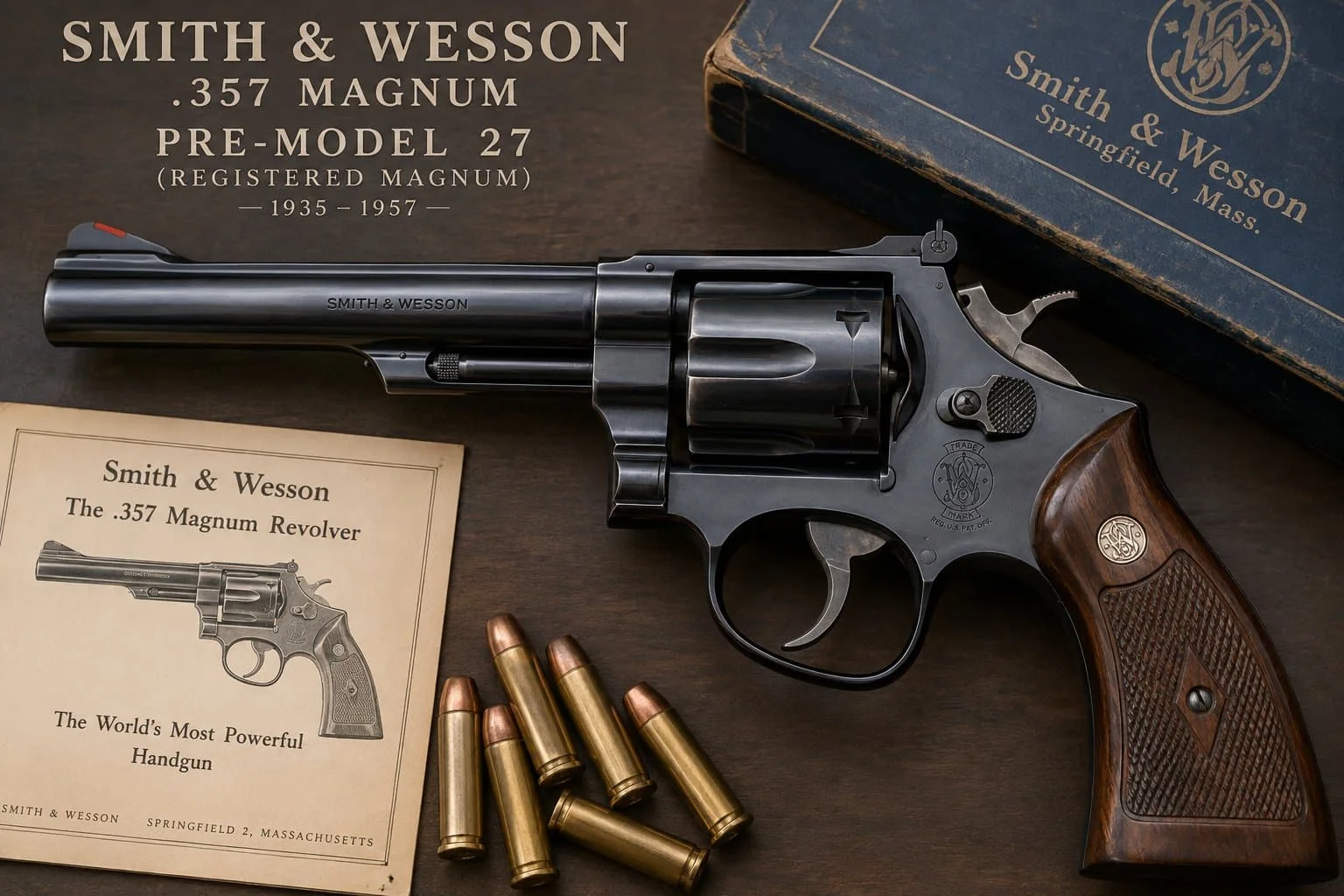
Collectors use Registered Magnum for Smith & Wesson’s earliest .357 Magnum revolvers. S&WHF’s serial-number guide states that those earliest .357 Magnums had a registration number stamped in the yoke cut, written like REG 3000 for registration number 3000.
That REG number is not the serial number of record.
Smith & Wesson ended the registration program in 1939 but continued making non-registered .357 Magnums until wartime production priorities intervened in 1941. Production resumed in 1948. In 1957, when Smith & Wesson adopted model numbers, the .357 Magnum became the Model 27.
That makes the Registered Magnum, the later pre-model-number .357 Magnum, and the Model 27 one collector lineage—but not one paperwork category. A revolver made after the registration program ended should not be described as a Registered Magnum simply because it predates the Model 27 marking.
| Era | Collector identification | What to verify |
|---|---|---|
| 1935–1939 | Registered Magnum | Grip-frame serial plus a REG number in the yoke cut; surviving registration paperwork is separate evidence |
| 1939–1941 | Non-Registered .357 Magnum | No assumption that a REG number or certificate should exist |
| 1948–1957 | Postwar pre-model .357 Magnum | Postwar features, grip-frame serial, and factory records |
| 1957 onward | Model 27 and later engineering variants | MOD 27 or dash marking, grip-frame serial, features, and factory records |
Lookalikes that fool people—and search engines
| Gun | Why collectors confuse it | Quick separation |
|---|---|---|
| Model 19 / Combat Magnum | Also .357 Magnum | K-frame—smaller; see GCC Model 19 and K-frame guides |
| Model 28 Highway Patrolman | Also N-frame .357 Magnum | Duty-oriented sibling, typically with a plainer finish and features than the deluxe 27; confirm stamps |
| Model 29 | Same N-frame size | .44 Magnum chambering and model stamp—not a 27 |
| .38/44 Heavy Duty / Outdoorsman | Large-frame ancestors in the Magnum origin story | .38 Special on an N-frame; different cartridge and model identity |
Do not merge identities from a naked serial. Frame size, chambering, and the yoke/model marks beat a digit string every time.
Serial number discipline—read this twice
The serial of record
For Smith & Wesson revolvers, S&WHF is unambiguous:
- The serial number of record is stamped on the grip frame, usually the bottom (butt).
- Target stocks often hide it. Carefully remove the grips to read and photograph the full stamp.
- Include any letters that appear before or within the serial.
- A few early-20th-century small-frame exceptions used the front strap. That is not the usual Model 27 case, but the rule remains “grip frame of record,” not “whatever number is convenient.”
That butt serial is what belongs on a letter order, a bound-book entry, and an insurance schedule.
What the yoke-cut numbers often are
Inside the yoke cut you may see:
- An assembly number, a random fitting number that is not in the archive index for lettering
- A model / dash stamp such as
MOD 27orMOD 27-3on numbered guns - On the earliest .357 Magnums, a REG #### registration number
S&WHF says assembly numbers were not recorded as serials and are not useful for archival research. Colt collectors sometimes expect the yoke-cut number to be the serial; that habit causes S&W lettering mistakes.
Matching barrel and cylinder numbers
Older practice sometimes repeated the serial under the barrel and on the cylinder. Mismatches usually mean mixed parts. Absence of barrel or cylinder serialization is not automatically a problem; factory practice changed over time.
Star next to a serial
A star (☆) beside a serial often marks major factory service or refinish work, sometimes with a date code inside the grip frame. That is service-history context—not a substitute for a letter, and not automatic “ruined” or “enhanced” value language.
What public dating can and cannot do
What works as a lead
- Model and dash literacy from the yoke stamp on numbered guns, checked against a current Standard Catalog of Smith & Wesson. S&WHF recommends the fifth edition as a comprehensive published reference.
- Feature chronology such as pinned vs unpinned barrel, recessed vs non-recessed chambers, screw-count or sideplate changes, and stock style—always as supporting clues, never as a fake serial chart.
- Approximate published serial tables in collector catalogs—as a lead.
What does not work
- Treating a chart year as a ship date. S&WHF says shipping documentation is the reliable “born on” date it can defend; guns were not shipped in sequential serial order.
- Looking up a bare number with no model confirmation in overlapping pre-letter-prefix ranges.
- Using the REG number as if it were the serial.
Explicit for this page: no serial-number-to-year tool UI, no pasted unverified dash-to-year master table, and no “letter adds $X” claims.
Model 27 dash numbers—literacy without a fake calendar
On numbered guns, a dash after the model—27-2, 27-3, and so on—marks an engineering revision, not a marketing trim name.
How to use dashes here:
- Read the exact yoke stamp and photograph it.
- Compare the stamp and physical features to a current Standard Catalog of Smith & Wesson entry for Model 27.
- Treat catalog dash eras as published secondary guidance.
- When ship date, destination, or as-shipped configuration matters, order a letter instead of arguing chart edges.
GCC is not pasting a home-brew Model 27 dash calendar into this article. If a sourced table is added later, it will be attributed, caveated, and approved like intentional sourced estimators elsewhere on the site.
When a Model 27 or Registered Magnum factory letter is worth it
Order through the Smith & Wesson Historical Foundation letter service. The process is also summarized in GCC’s Factory Letters for Collectors guide.
Fees—confirm live before you pay
Checked on the live S&WHF letters page September 24, 2026:
| Order type | Listed fee |
|---|---|
| Standard Letter of Authenticity | $100 USD |
| S&WCA or S&WHF member | $90 |
| Member of both | $75 |
| International shipping outside the U.S. | +$8 |
Membership claims are double-checked. Fees change; re-read the live letters page when you order.
What the letter typically includes
For most manufacturing periods, S&WHF describes letters that document original factory specifications such as finish, barrel length, and grip style; the initial shipping destination; and the departure date from the factory, plus copies of additional related documents when preserved.
What it will not do
- Provide a full civilian ownership chain after the first ship-to, often a distributor
- Appraise the gun or “add $X” simply by existing
- Authenticate today’s finish as original by inspecting the metal
- Turn a REG number into a serial lookup
- Prove a famous later owner without archive-recorded evidence
Worth the fee when
- You need as-shipped barrel length, finish, or stock style confirmed.
- Registered Magnum or early Magnum paperwork claims need the archive, not a brochure story.
- Police, agency, or special-ship claims matter to a buying, insurance, or publishing decision.
- High-condition, cased, engraved, or estate documentation needs a primary record.
Often skip when
- The revolver is a common shooter configuration with no special-order story.
- You only wanted a rough era and a careful catalog read already answers the question you actually have.
Practical ID checklist
- Confirm N-frame and .357 Magnum chambering—and that it is not a Model 19 K-frame.
- Photograph left and right profiles, yoke-cut marks, butt serial with grips off if needed, and barrel markings.
- Separate the butt serial from REG, assembly, and MOD marks.
- Note barrel length, sight type, finish, and stocks as they sit today.
- Compare features and model stamp to the Standard Catalog of Smith & Wesson as a lead.
- Rule out the common lookalikes: Model 28, Model 29, and K-frame Model 19.
- Order a letter when ship configuration or destination changes the decision.
Choose your next research step
Researching another firearm? Start with the complete firearm serial-number and identification index. For focused Combat Magnum context, use the Model 19 serial-date reference or the Smith & Wesson .357 collector guide.
Possible future companions: a Model 28 Highway Patrolman identification page and a Model 29 / .44 Magnum N-frame guide.

About Greg Cook
Greg Cook writes about firearms collecting, identification, and the stories behind interesting guns. His Army MOS was 76Y, Unit Armorer, and he brings that practical background to his collector guides.
Sources consulted
- Smith & Wesson Historical Foundation, Letters / Letter of Authenticity—fees and order rules checked September 24, 2026
- Smith & Wesson Historical Foundation, Smith & Wesson Serial Numbers—serial of record, REG number, and assembly vs model stamps
- Smith & Wesson Historical Foundation, Factory Letter FAQ—ship date as dating anchor, nonsequential shipping, and name-to-number transition
- Gun Collectors Club, Factory Letters for Collectors—GCC’s S&W fee and process overview
- Standard Catalog of Smith & Wesson, fifth edition—secondary catalog reference for dash and feature literacy, not a substitute for a factory letter
- American Rifleman, “This Old Gun: Smith & Wesson Registered Magnum”—October 1939 end of the registered program and the non-registered prewar continuation
- American Rifleman, “The History of the .357 Magnum”—wartime interruption, postwar resumption, and 1957 Model 27 designation
Auction-house Magnum histories were reviewed as leads only and are not used here as serial tables or production-count authorities.