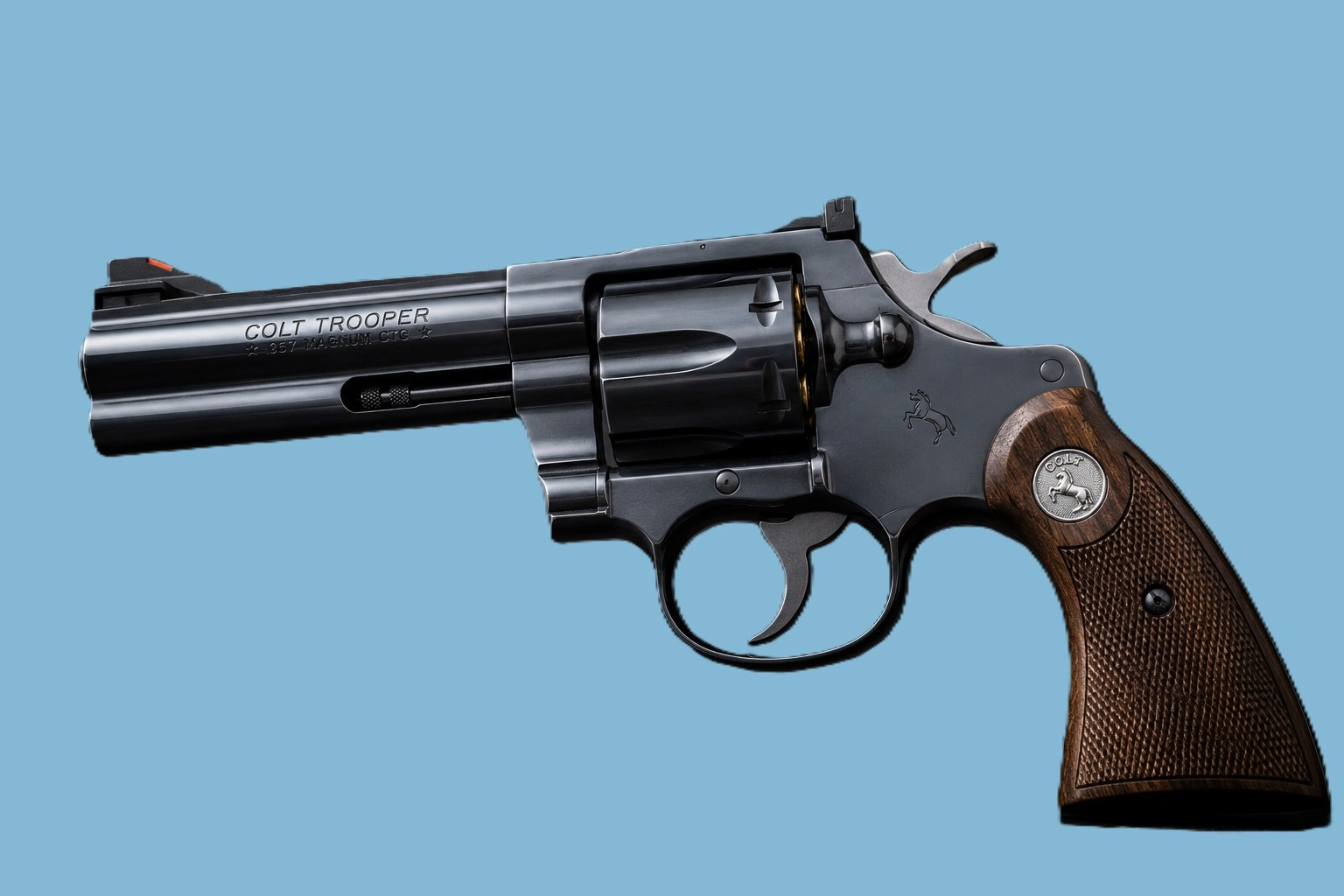
The Colt Trooper is one of those revolvers that becomes more interesting the longer you study Colt history. A long-time old friend of mine Larry Hardin, was an Alabama State Trooper from the early 1960s to the mid 1990s. Larry recounted several moments when, instead of firing, he flipped the revolver around and delivered a strike with the butt, or simply swung the heavy gun like a club while keeping it in a normal grip. These guns were not as plain as some of Colt’s earlier service revolvers and weighed in at more than 2 lbs. It sits in the middle: a serious working handgun with enough Colt character to keep collectors interested.
For additional model and manufacture-year context, visit the Colt Trooper production research in the Colt serial-number lookup tool.
The Trooper name also creates confusion because Colt used it across more than one mechanical generation. An early Trooper, a Trooper .357, a Trooper Mark III, and a Trooper Mark V should not all be treated as the same revolver. The markings, action type, caliber, finish, and serial-number range all matter.
Overview
The original Colt Trooper was introduced in the 1950s as a service and field revolver. It offered adjustable sights and Colt double-action handling without the high-polish presentation of the Python. Early Troopers used older Colt-style lockwork. Later Mark III and Mark V revolvers used redesigned actions that moved Colt into a more modern production era.
Collector takeaway: The Trooper is not just “a cheaper Python.” It is its own Colt revolver family, and the exact generation determines how it should be evaluated.
| Trooper Family | General Era | Collector Notes |
|---|---|---|
| Original Colt Trooper | 1950s–1960s | Earlier Colt action, adjustable sights, service revolver profile, and strong appeal to old-action Colt collectors. |
| Trooper .357 | 1950s–1960s | Important pre-Mark III .357 Magnum variation that is often compared with other early Colt magnum revolvers. |
| Trooper Mark III | Late 1960s–1980s | Redesigned action with transfer-bar safety and coil mainspring. Strong, useful, and often undervalued compared with older Colts. |
| Trooper Mark V | 1980s | Later action generation with a shorter lock time and less common production profile than the Mark III. |
How to Identify
Start with the barrel marking. Look for “Trooper,” “Trooper .357,” “Trooper MK III,” or “Trooper MK V.” Then confirm caliber, barrel length, finish, stocks, and serial number. Colt model names can overlap in collector conversations, so the revolver itself needs to do the talking.
What to Check First
- Exact barrel marking and caliber marking
- Serial number location and prefix or suffix pattern
- Barrel length, sight style, and ejector shroud
- Blue, nickel, or later finish condition
- Correct Colt stocks for the period
Warning Signs
- Rounded edges or washed-out rollmarks
- Mixed-period grips or incorrect replacement stocks
- Timing issues, poor carry-up, or excessive endshake
- Seller descriptions that call every Colt .357 “Python-like”
- Serial number claims without model verification
Serial Number Research
Colt serial number research is useful, but it should be used carefully. The Trooper name covers multiple generations, and serial-number tables may be grouped by frame, model family, or production block. For a quick starting point, use the Colt Serial Number Lookup App. For broader research, start with the Firearm Serial Number Guides hub.
Important: Published serial-number tables are research aids, not factory confirmation. For a high-value Trooper, a Colt factory letter may help confirm shipment date, original finish, barrel length, and destination.
Original vs. Mark III
The original Trooper and the Trooper Mark III are often discussed together, but mechanically they are very different revolvers. The Mark III represented a major redesign by Colt. It used a transfer-bar safety system, a coil mainspring, and a different internal action from the older Colt lockwork.
| Feature | Original Trooper | Trooper Mark III |
|---|---|---|
| Action System | Earlier Colt double-action lockwork | Redesigned Mark III action |
| Safety System | Traditional Colt system | Transfer-bar safety |
| Collector Appeal | Old-action Colt interest | Strong shooter-grade Colt interest |
| Common Comparison | Often compared with early Colt service and target revolvers | Often compared with Lawman, Official Police Mark III, and other later Colt revolvers |
The Mark V
The Trooper Mark V followed the Mark III and is less commonly encountered. It used a later action system and tends to interest collectors who want to trace Colt’s double-action development across generations. A nice Mark V can be a useful companion piece beside a Mark III, Python, Lawman, or other late Colt revolver.
Condition and Value Factors
Condition and originality drive Trooper values. The highest collector interest usually goes to revolvers with sharp rollmarks, correct stocks, strong original finish, clean mechanics, and supporting box or paperwork. A shiny refinish is not the same thing as original condition.
- Original finish: Blue and nickel examples should be checked carefully for polishing and refinishing.
- Mechanical condition: Check lockup, carry-up, cylinder endshake, and double-action function.
- Correct grips: Period-correct Colt stocks can materially affect value.
- Barrel length: Four-inch and six-inch revolvers are the most familiar configurations, but exact desirability depends on model generation.
- Box and papers: Original packaging adds value, especially on high-condition examples.
Common Buyer Mistakes
The most common mistake is paying for a name instead of a revolver. The Trooper is a collectible Colt, but the model family, finish, originality, and mechanical condition must support the price.
- Calling every Trooper a “poor man’s Python.”
- Failing to distinguish original Trooper, Trooper .357, Mark III, and Mark V examples.
- Ignoring signs of refinishing because the revolver looks clean.
- Not checking timing and lockup before purchase.
- Overlooking incorrect replacement grips.
- Using serial number alone without confirming the barrel marking and configuration.
Related Colt Revolver Guides
Use the Colt revolver cluster to compare the Trooper with other Colt double-action revolvers and serial-number resources.
Collector Resources
Collector Tools & Supplies
Serious collectors rely on a few basic tools to inspect, document, preserve, and store collectible firearms. These internal guides cover the supplies most useful for research, safe storage, photography, and collection records.

About Greg Cook
Greg Cook writes about firearms collecting, personal history, and the stories behind interesting guns. His Army MOS was 76Y, Unit Armorer, and he brings that practical background to his collector articles.
Sources Consulted
- Colt factory catalogs and period advertising literature
- R.L. Wilson, Colt reference works
- Colt historical model references and collector observations
- Author observations from Colt double-action revolver examples