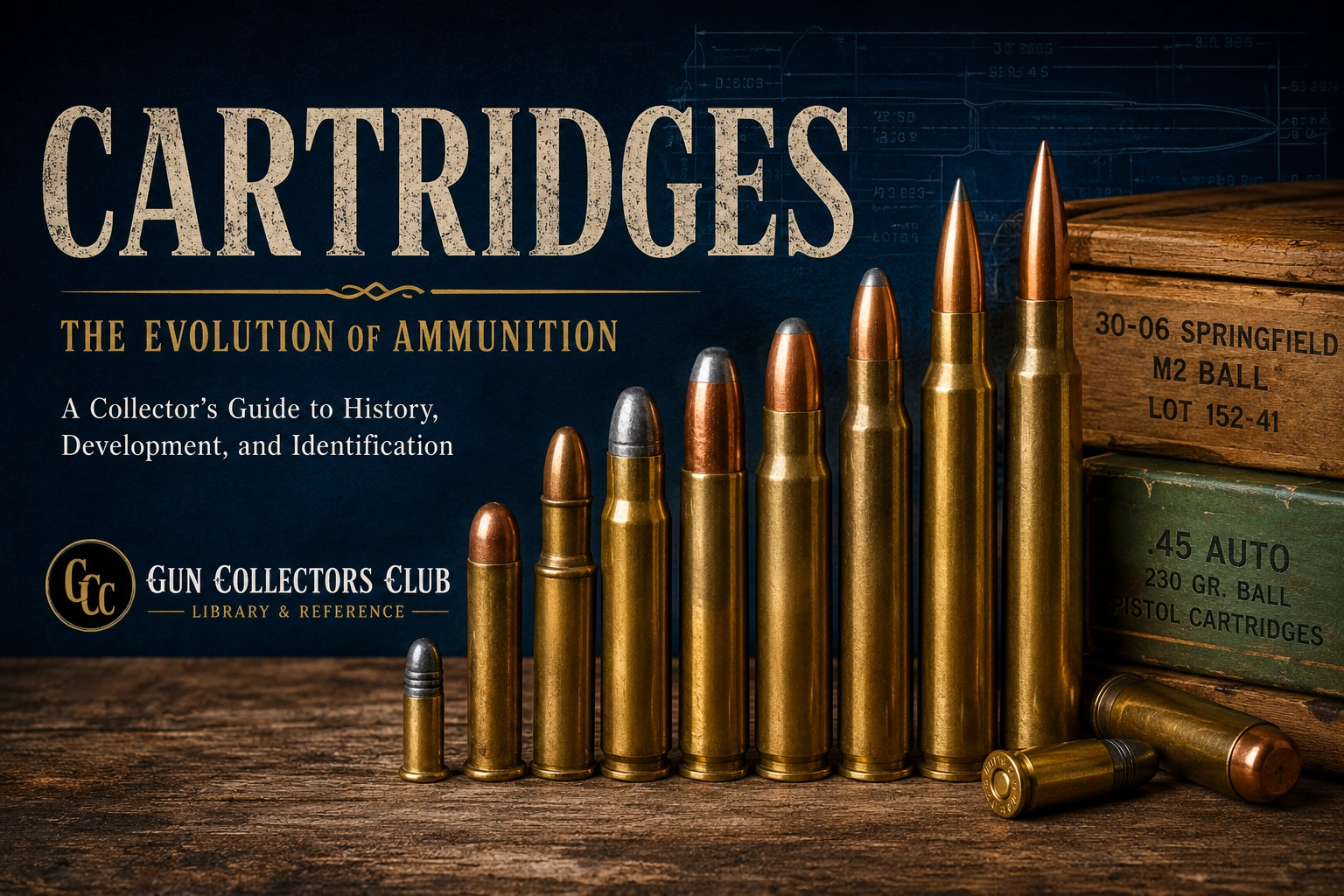
Firearm Cartridges and Ammunition History belongs in the Gun Collectors Club Reference Library because it helps place individual firearms inside a larger collector story. A good reference article should do more than define a term. It should explain why the subject mattered, how collectors evaluate it, and where the reader should go next.
Collectors make better decisions when model details are connected to history, production changes, and design intent.
Why Cartridges Matter
Cartridges are the hidden framework behind firearm history. A rifle, revolver, or pistol is often remembered by its mechanism, but the cartridge determines pressure, range, recoil, case design, feeding behavior, and practical usefulness.
Collectors who understand cartridges often understand firearms more clearly. The chambering can explain why a design succeeded, why it faded, or why a specific variation is desirable.
From Black Powder to Smokeless Powder
Early metallic cartridges used black powder and transformed firearms by simplifying loading and supporting repeating designs. Smokeless powder later changed the scale of firearm performance by producing higher velocity with less fouling.
This shift helped make small-bore, high-velocity military rifles practical and influenced sporting rifles for generations.
American Sporting and Military Cartridges
American collectors frequently encounter cartridges such as .30-30 Winchester, .45 ACP, .30-06 Springfield, .22 Long Rifle, .38 Special, .357 Magnum, .41 Magnum, .44 Magnum, and .308 Winchester. Each carries its own history, collector associations, and firearm families.
Ammunition as Collector Evidence
Ammunition boxes, headstamps, loading labels, and period cartridges can support a firearm display or help place a gun into its proper era. For collectors, ammunition is often the paper trail that survived alongside the gun.
Metallic Cartridge Development and Innovation
The development of the self-contained metallic cartridge changed firearms history permanently. Earlier firearms required separate powder, projectile, and ignition components. Metallic cartridges combined those elements into a single unit that improved reliability, speed of loading, and weather resistance.
Rimfire cartridges became popular first because of their simplicity, but centerfire cartridges ultimately dominated military and sporting use because they handled greater pressure and allowed reloadability.
Headstamps, Ammunition Boxes, and Collector Research
For collectors, ammunition can become a research category of its own. Headstamps identify manufacturers, military contracts, production periods, and sometimes even wartime shortages or export production.
Original ammunition boxes are especially valuable because they often preserve period graphics, loading data, pricing information, and cartridge designations that changed over time.
| Collector Question | Why It Matters |
|---|---|
| What cartridge is it chambered for? | Chambering often determines use, era, recoil, and collector interest. |
| Is the cartridge period-correct? | Correct ammunition can support a display or research conclusion. |
| Are boxes or labels present? | Original boxes can add context and sometimes value. |
| Does the chambering match the model? | Some rare chamberings are worth investigating carefully. |
Collector Insight
The cartridge is often the real innovation.
Collectors sometimes focus on the gun and overlook the ammunition, but many firearms only became important because a cartridge made them practical.
Related Reading
Build Your Reference Shelf
Library articles are strongest when paired with good books, careful photos, magnification, and a patient research process. I keep a curated list of reference books and collector tools for this kind of work.
Shop My LibraryAs an Amazon Associate I earn from qualifying purchases.

About Greg Cook
Greg Cook writes about firearms collecting, personal history, and the stories behind interesting guns. His Army MOS was 76Y, Unit Armorer, and he brings that practical background to his collector articles.