What Was Special About the Special?
When the Colt Officers Model Special appeared at the start of the 1950s, it represented Colt's postwar answer to the serious target-revolver buyer. The name can be a little confusing because Colt used the word Special on several unrelated handguns, but this revolver is not a Detective Special, not an Official Police, and not the later Officers Model Match. It is the short-run target model that sits between the prewar and immediate postwar Officers Model Target tradition and the 1953 Officers Model Match.
For additional model and manufacture-year context, visit the Officers Model Special research in the Colt serial-number lookup tool.
The appeal is partly mechanical and partly historical. Mechanically, the Officers Model Special gave the shooter a medium-frame Colt double-action revolver with a six-shot cylinder, a heavy six-inch barrel, adjustable target sights, and the weight-forward balance that target shooters liked. Historically, it captures a very narrow postwar moment: Colt was updating its revolver line, Smith & Wesson was pushing hard in the target-revolver market, and American shooters still expected a fine rimfire or .38 target revolver to be built from steel, polish, handwork, and careful sight regulation.
The Officers Model Special is best understood as a bridge gun: old-world Colt target-revolver craftsmanship on one side, the later Officers Model Match and Python-era sight system on the other.
Collector Snapshot
Colt Officers Model Special .22 LR at a Glance
This page focuses on a 1950 Colt Officers Model Special target revolver chambered in .22 Long Rifle. The model was also offered in .38 Special, but the rimfire chambering has a special place with collectors because it connects the gun to bullseye practice, indoor target work, and the classic American .22 revolver tradition.
Model
Colt Officers Model Special, fourth major Officers Model variation.
Chambering
.22 Long Rifle, six-shot, double-action/single-action revolver.
Target Features
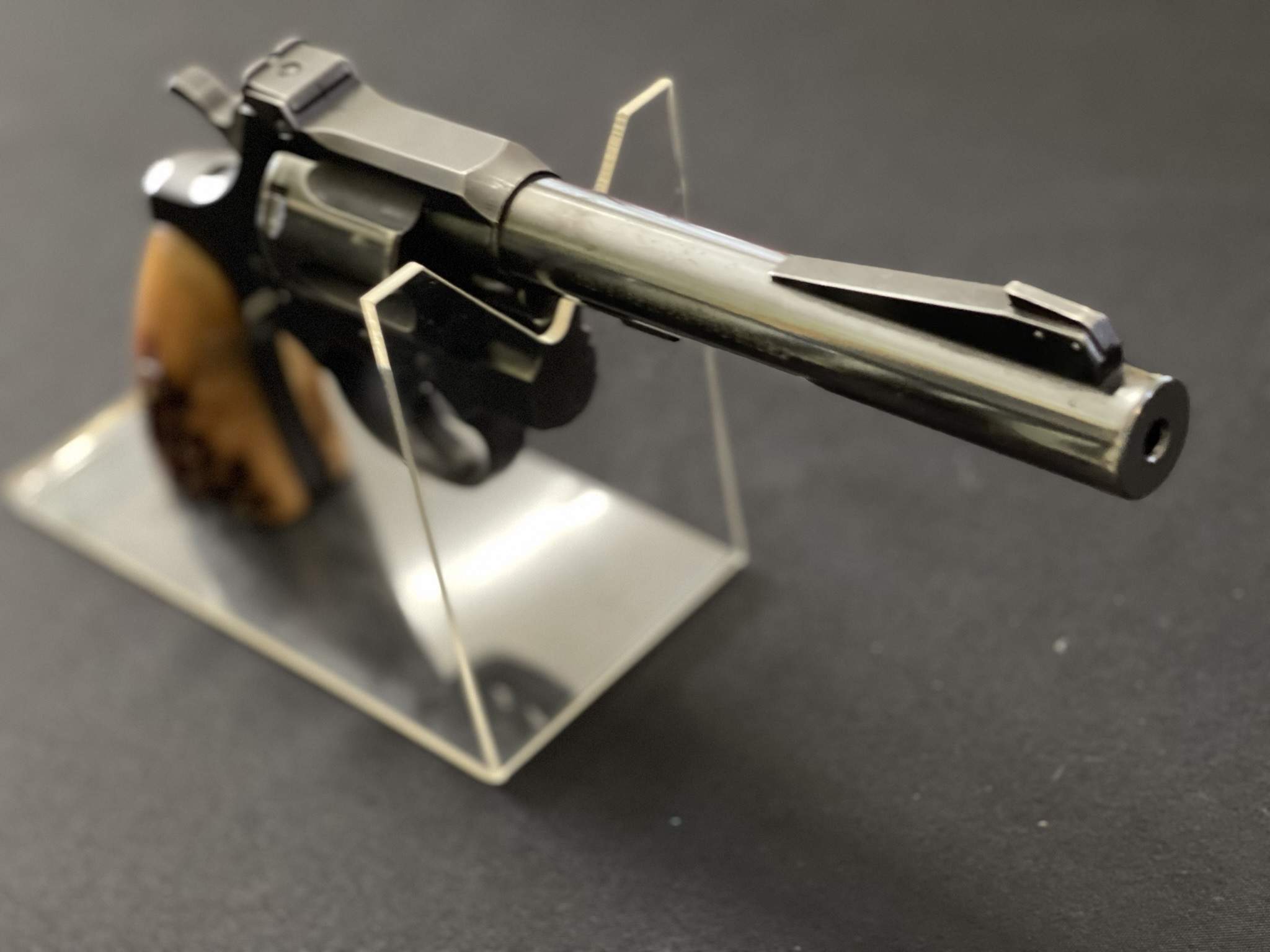
Six-inch heavy barrel, Coltmaster adjustable rear sight, ramp front sight, and target-oriented handling.
Collector Angle
Short production window, transitional postwar design, and strong comparison value beside the Smith & Wesson K-22.
1950 Colt Officers Model Special .22 Long Rifle
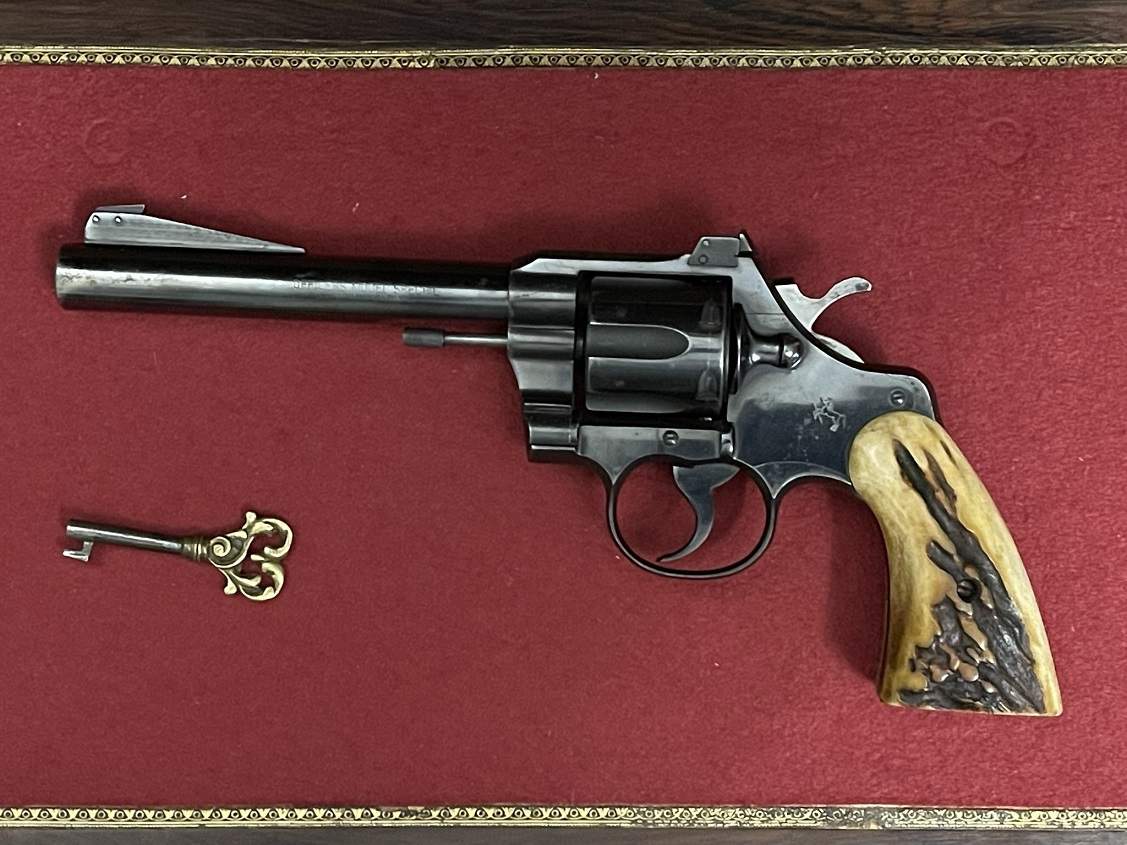
The featured revolver is a 1950 example chambered in .22 Long Rifle. The rear sight is Colt's Coltmaster sight, adjustable for windage and elevation. The long ramp front sight gives the revolver a distinctive profile, while the heavy barrel and full-sized grip frame make it feel more like a serious match revolver than a casual plinker.
One reason the .22 LR version is so attractive is that it lets a collector study the same Colt target-revolver architecture without the recoil, ammunition cost, or centerfire wear associated with high-volume .38 Special shooting. The revolver still has the heft, sight radius, and trigger feel of a full-sized target Colt, but its rimfire chambering places it in the world of deliberate practice, slow-fire accuracy, and paper-target work.
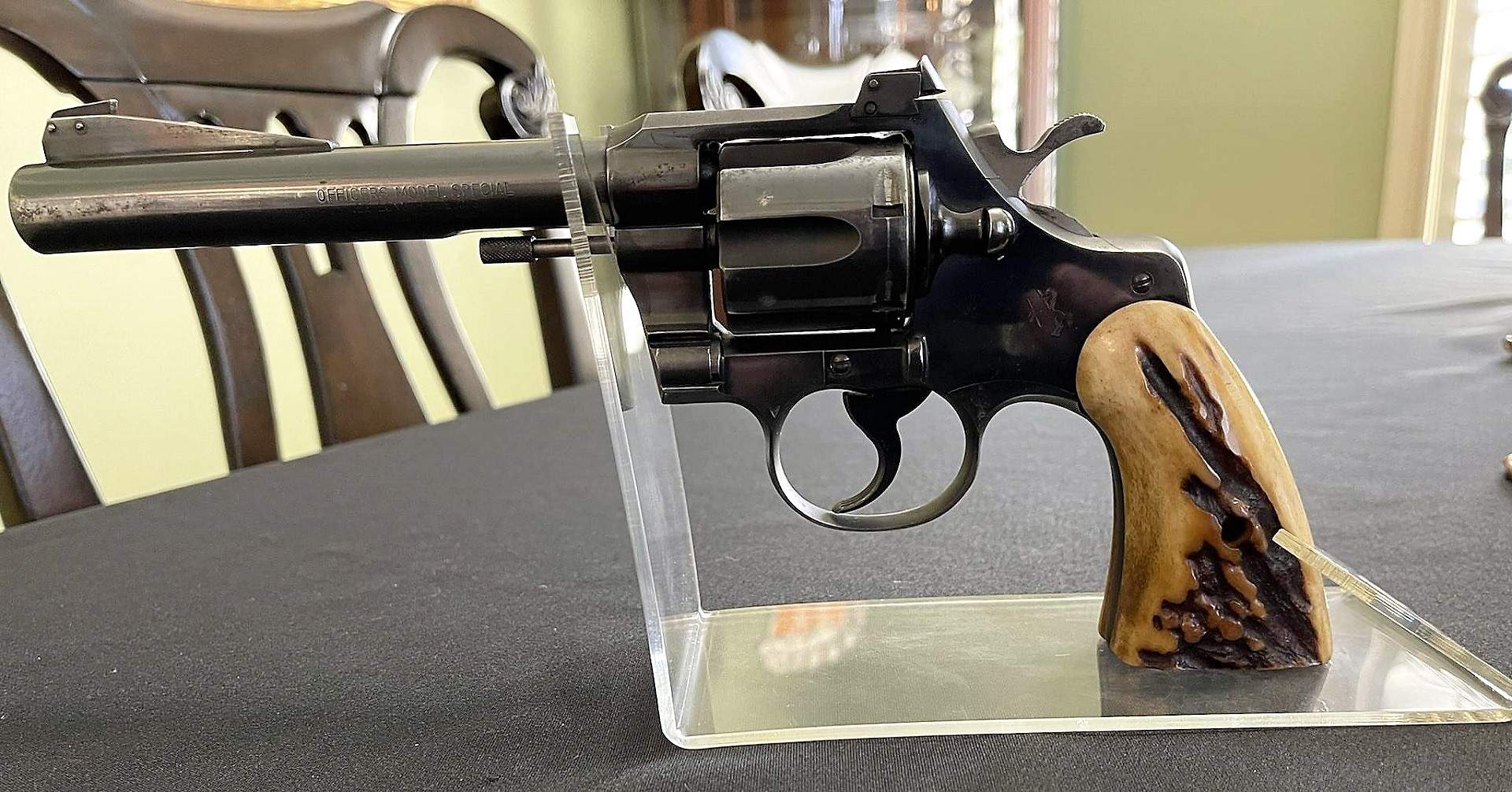
The seller described the left side of the barrel as marked OFFICERS MODEL SPECIAL over .22 LONG RIFLE CTG. The right side was marked COLT'S MFG. CO. HARTFORD, CT U.S.A. Those barrel markings matter because many Officers Model revolvers are casually described online with overlapping names. A buyer should distinguish the Officers Model Target, Officers Model Special, and Officers Model Match before assigning collector value.
Purchase Price Breakdown
Collectors often remember the winning bid but forget the real landed cost. The all-in price is the number that belongs in a collection ledger because it reflects what the gun actually cost to acquire and put in hand.
- Online auction winning bid: $1,050
- Lost 3% cash discount for paying by credit card: $31.50
- Sales tax: $107.84
- Shipping: $40
- Total acquisition cost: $1,230.00, rounded to the nearest dollar for collector notes.
That 2021 purchase price should not be read as a universal market value. It is one collector's real acquisition cost for one revolver, with a specific condition profile, a specific set of grips, and the added costs that come with buying through an online auction. For insurance or resale notes, I would keep the invoice, auction description, photos, and any later factory-letter documentation together.
History and Identification
The Colt Officers Model family was a medium-frame, double-action target-revolver line produced across much of the twentieth century. The broad family includes the Officers Model Target, Officers Model Target Rimfire, Officers Model Special, and Officers Model Match. That long family history is useful, but it also creates confusion because sellers often blend the names together.
The Officers Model Special is the postwar transitional version. It has the heavy six-inch barrel and Coltmaster adjustable rear sight associated with the Special, and it predates the later Officers Model Match with the Accro rear sight. In simple collector language, the Special is the short-run target Colt of the early 1950s, while the Match is the better-known successor that carried the Officers Model name deeper into the postwar era.
This example wears replacement stag grips. They give the revolver strong visual character, but they are not the typical original grip configuration for the model. Standard postwar references describe the Officers Model Special with reddish-brown Coltwood service-style plastic stocks. Original grips, original box, and matching paperwork can matter significantly when comparing two otherwise similar revolvers.
Production Years
The Officers Model Special occupies a short production window. Most collector references place the model in the 1949 to 1952 period, with the model appearing in the market around 1950 and then giving way to the Officers Model Match in 1953. That makes the Special a compact chapter in a much longer Officers Model story that stretches from the early twentieth century into the postwar target-revolver era.
That short production run is part of the attraction. Colt did not make the Officers Model Special for decades. It did not become a mass-market police gun. It lived in the narrow space between the older target models and the later Match variation, which means a correct Special should be examined as its own model rather than as a generic Officers Model.
| Period | Collector Significance |
|---|---|
| Pre-1949 context | Earlier Officers Model Target and rimfire target revolvers established Colt's reputation in the precision revolver market. |
| 1949-1950 introduction period | The Officers Model Special emerged as Colt's postwar target update with the Coltmaster sight and heavy six-inch barrel. |
| 1950 featured example | This .22 Long Rifle revolver belongs to the heart of the model's short production period. |
| 1951-1952 continuation | Short-run production continued in .22 LR and .38 Special before the model was replaced. |
| 1953 transition | The Officers Model Match succeeded the Special and used the later Accro-style sight system. |
Variants and Configurations
The Officers Model Special is not a large variant family like the Python or the long-running Official Police. Its collector interest comes from a tight set of correct features. The most important configuration points are chambering, barrel, sight system, finish, and stocks.
| Feature | Correct Special Notes | Collector Check |
|---|---|---|
| Chambering | .22 Long Rifle and .38 Special are the standard chamberings associated with the Officers Model Special. | Read the barrel marking and verify the chambering against the cylinder and paperwork. |
| Barrel | Six-inch heavy, untapered target barrel. | Look for altered muzzle condition, front sight damage, and evidence of refinishing. |
| Rear sight | Coltmaster fully adjustable rear sight. | Confirm the sight is present, functional, and not substituted with a later style. |
| Finish | Blued finish is the standard finish generally associated with the model. | Inspect screw slots, edges, lettering, and polish lines for signs of refinish. |
| Stocks | Reddish-brown Coltwood service-style plastic stocks are commonly cited as original equipment. | Replacement stag, target, or aftermarket stocks may be attractive but should be described accurately. |
The featured revolver scores well on model identity because the barrel markings, chambering, sighting arrangement, and overall profile fit the Officers Model Special story. Its replacement stag grips should be called out clearly so a future buyer, appraiser, or family member does not mistake them for factory-original stocks.
Serial Number Ranges and Dating Notes
Serial-number dating is one of the places where older Colt revolvers can frustrate collectors. Colt serial sequences may overlap between models, online tables can be incomplete, and the same raw number can sometimes produce multiple possibilities unless it is interpreted with the model, markings, frame type, and physical configuration.
For this reason, the best practice is to treat the serial number as one part of the identification process rather than the entire process. Start with the barrel marking, chambering, frame size, sight system, and barrel profile. Then use Colt's serial-number lookup as an approximate date tool. For a definitive collector record, a Colt Archive Letter is the stronger document because it can confirm factory shipping details when records are available.
| Dating Tool | Use | Limitation |
|---|---|---|
| Barrel markings | Confirm the gun is marked Officers Model Special and identify the chambering. | Barrels can be changed, so markings should be supported by the rest of the gun. |
| Serial-number lookup | Provides an approximate manufacture-year anchor. | Not comprehensive and not a substitute for factory documentation. |
| Physical configuration | Heavy barrel, Coltmaster sight, and postwar features help separate the Special from other Officers Models. | Parts substitutions can blur the picture on guns that have been modified. |
| Colt Archive Letter | Best route for shipment date, original configuration, and destination when records exist. | Availability and detail vary by firearm and archive record. |
Collector Notes
The .22 LR Officers Model Special appeals to a specific kind of Colt collector. It is not as visually famous as the Python, not as common as the Official Police, and not as widely recognized as the Smith & Wesson K-22. That relative obscurity is exactly why it is interesting. It rewards the collector who looks closely at short production windows, sight variations, grip correctness, and postwar Colt changes.
Condition remains the first value driver. Strong blue, sharp barrel markings, a clean muzzle, clean screw slots, and crisp edges all support collector confidence. The Coltmaster rear sight is especially important because it is a defining feature of the Special. A missing, damaged, or replaced sight should materially affect both description and price.
Original stocks matter as well. The stag grips on this revolver are attractive and may be part of its ownership history, but a factory-correct pair of Coltwood stocks would make the package more complete from a strict originality standpoint. A collector who enjoys the gun as acquired can keep the stag grips on it, while still documenting that they are replacements.
- Best collector package: correct model, excellent original blue, correct Coltmaster sight, original stocks, box, paperwork, and factory letter.
- Still desirable: honest finish wear, correct markings, correct sight, mechanically sound condition, and clear disclosure of replacement grips.
- Value reducers: refinish, altered front sight, missing Coltmaster parts, wrong barrel, damaged screw slots, pitting, heavy cylinder wear, or undocumented claims of rarity.
Known Issues and Ownership Checks
Older Colt double-action revolvers deserve careful inspection. This section is not a repair manual; it is a collector checklist. Any revolver intended for firing should be inspected by a qualified gunsmith familiar with vintage Colt lockwork, especially if its maintenance history is unknown.
| Area | What to Look For | Why It Matters |
|---|---|---|
| Timing and lockup | Consistent cylinder carry-up and lockup on every chamber. | Vintage Colt actions can be smooth and precise, but repairs require specialized knowledge. |
| Endshake and crane fit | Excess cylinder movement, sprung crane, or uneven cylinder gap. | Wear or abuse can affect both safety and value. |
| Coltmaster rear sight | Missing screws, bent sight parts, damaged adjustment slots, or loose fit. | The Coltmaster sight is a model-defining part and can be harder to replace than ordinary service sights. |
| Bore and chambers | Lead fouling, corrosion, ringed bore, damaged crown, or rough chambers. | .22 LR revolvers can accumulate fouling; condition is central to shooter and collector value. |
| Finish and markings | Rounded edges, washed lettering, buffed proof marks, or mismatched polish. | These can indicate refinishing, which affects originality. |
| Stocks and screws | Cracked stocks, over-tightened grip screw, buggered sideplate screws, or non-period replacements. | Small parts tell the story of how a revolver was handled over decades. |
For storage, the same old-gun rules apply: avoid long-term leather contact, keep fingerprints wiped from blued steel, control humidity, and store documentation separately from solvents or oil. A light preservation routine protects both the gun and the story attached to it.
Value Trends
The market for the Colt Officers Model Special is uneven because many sales listings use imprecise names. Some examples labeled “Officers Model Special” are actually Officers Model Target or Officers Model Match revolvers. Some listings blend .22 LR and .38 Special. Some value sites also mix shooter-grade examples with better collector-grade guns. For that reason, exact comparable sales matter more than a single average number.
As a broad market check in 2026, online value aggregation showed a used average near the middle hundreds for generic Officers Model Special listings, while individual sold examples varied widely. That kind of number is useful only as a baseline. A clean, correct, well-photographed .22 LR Special with the right sight and strong finish can bring more than a generic average, while a refinished or parts-mixed revolver should be discounted.
| Value Factor | Effect on Price |
|---|---|
| Condition | Original blue, sharp markings, clean bore, and minimal muzzle/cylinder wear support stronger value. |
| Correct sight | The Coltmaster sight is central to the Special; damaged or substituted sights reduce confidence. |
| Original stocks | Correct Coltwood stocks improve originality; attractive replacements should still be identified as replacements. |
| Documentation | Factory letter, invoice, auction description, and clear photographs help support insurance and resale value. |
| Chambering | .22 LR often draws strong target-revolver interest, but price still depends on condition and completeness. |
| Listing accuracy | Misidentified Target, Special, and Match revolvers can distort market averages. |
The 2021 all-in cost of $1,230 for this revolver sits above a generic shooter-grade average, but it reflects a real purchase of a short-run Colt target revolver in .22 LR with strong visual appeal. Whether that was high, low, or fair depends on the condition details, the buyer's goals, the replacement grips, and the comparable sales available at the time.
Colt vs. Smith & Wesson in the 1950s
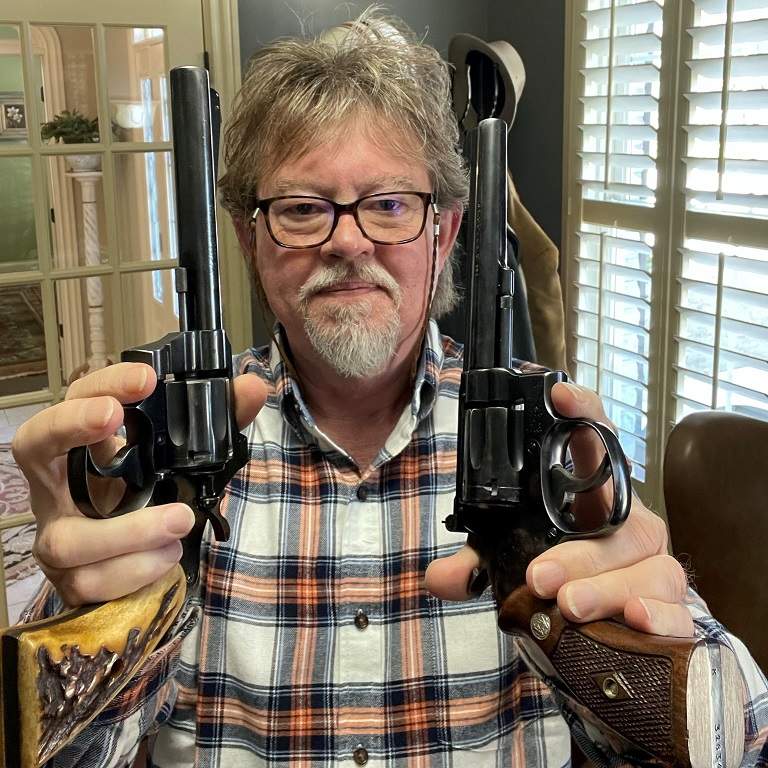
In the 1950s, Colt and Smith & Wesson were both building excellent factory target revolvers. A Colt Officers Model Special and a Smith & Wesson K-22 Masterpiece represent two different approaches to the same broad idea: a finely made, accurate, American target revolver. The Smith & Wesson K-22 became one of the benchmark rimfire target revolvers of the era, while the Colt Officers Model Special offered the distinctive Colt action feel, Colt sighting system, and a shorter production story.
That comparison is useful because it explains the Special's collector personality. The K-22 is often easier for shooters to recognize immediately. The Officers Model Special can require more explanation, but once the features are understood, the Colt becomes compelling precisely because it is less common and more transitional. For a related comparison, see Colt and S&W Go Head to Head.
Collector Takeaway
Final Word
The Colt Officers Model Special is easy to overlook if a collector only chases the most famous Colt names. It does not have the Python's celebrity or the Detective Special's pocket-gun recognition, but it has something quieter: a short production run, real target-shooting purpose, classic postwar Colt workmanship, and a strong place in the .22 target-revolver conversation.
This 1950 .22 LR example works because it tells several stories at once. It is a target revolver, a postwar Colt, a short-run transitional model, and a personal acquisition with documented purchase cost. The stag grips may not be factory original, but they add an ownership chapter worth preserving. For me, that is the heart of collecting: the factory story, the market story, and the individual gun's story all meeting in one piece of steel and blue.
Photo Notes
The photographs on this page should be treated as part of the collector record. For a revolver like this, the most useful images are not just glamour shots. A complete record should include both sides of the barrel, the muzzle, cylinder face, rear sight, front sight, frame markings, stocks, butt, screw slots, and any wear that future owners will want to understand.
Related Revolver Reading

About Greg Cook
Greg Cook writes about firearms collecting, personal history, and the stories behind interesting guns. His Army MOS was 76Y, Unit Armorer, and he brings that practical background to his collector articles.
Research Sources Consulted
This expanded page keeps the original collector notes and adds the Word-document-style research sections: production years, variants, serial-number dating notes, collector notes, known issues, and value trends. Use factory documentation and current sold results before making a final valuation on a specific revolver.
- Colt Fever: Colt Officer's Model revolver chronology and configuration notes
- Colt serial-number lookup for approximate manufacture-year research
- Colt Archive Services for factory-letter documentation
- TrueGunValue: Colt Officers Model Special price trend context
- Gun Collectors Club serial-number guide hub
- Gun Collectors Club: Colt and Smith & Wesson double-action revolver comparison