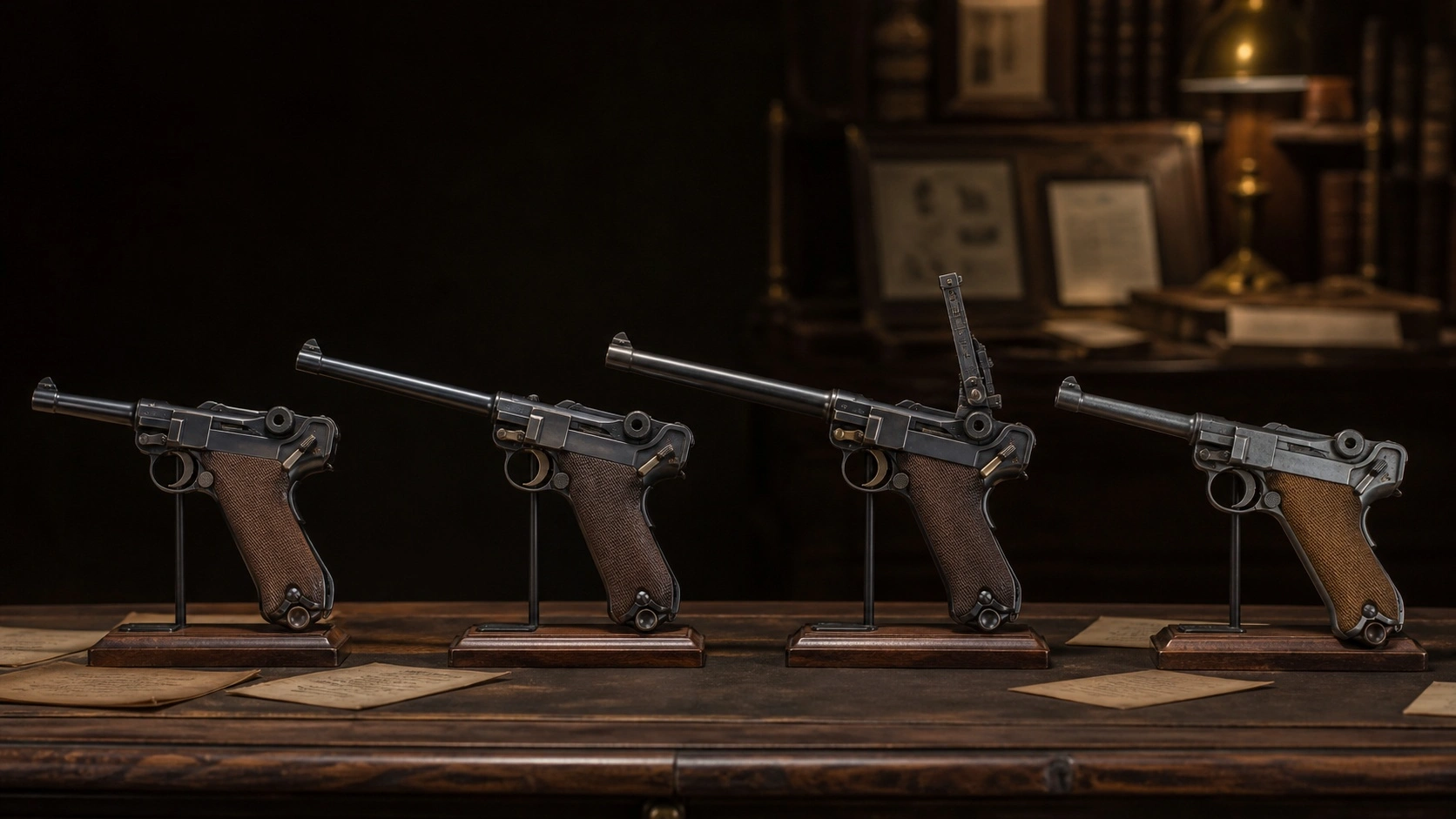
The word “Luger” describes a family of related pistols, not one fixed configuration. Barrel length, rear sight, chambering, grip treatment, safety details, markings, and intended market can separate a standard P08 from a Navy, Artillery, commercial, police, or carbine variation.
This guide begins with visible configuration because that is the safest first step. Use the profile to establish a likely variant family, then verify that impression with the complete serial number, suffix letter, chamber date, toggle mark, proofs, acceptance stamps, and numbered parts.
Identify the configuration first, then test it against the markings. A long barrel or unusual sight alone does not authenticate a rare Luger.
Quick Luger Variant Identification
| Likely family | First clues to examine | Verification priority |
|---|---|---|
| Standard P08 | Service-length barrel, fixed rear sight, familiar military profile | Maker, chamber date, proofs, suffix and matching parts |
| Artillery LP08 | Long barrel and tangent rear sight mounted on the barrel | Correct sight, stock lug, configuration and serialized parts |
| Navy | Longer barrel than the P08 and distinctive rear-sight arrangement | Naval markings, sight details, chambering and originality |
| Commercial | Commercial proofs, export features, varied chamberings and barrel lengths | Proof set, serial style, safety marking and market configuration |
| Police | Police property marks or unit markings; possible safety modifications | Marking consistency, sear/magazine safety evidence and period alterations |
| Carbine | Long barrel, fore-end and stock-oriented sporting configuration | Factory features, chambering, serialized components and provenance |
A Reliable Identification Sequence
P08 Army Lugers
The P08 is the classic German service Luger and the form most people picture when they hear the word “Luger.” It usually features the familiar short barrel profile and military layout associated with German service use.
For many collectors, a P08 is the practical entry point into Luger collecting. That does not mean it is simple. P08 values still depend on manufacturer, date, condition, markings, matching parts, magazine correctness, and whether the pistol has been refinished or altered.
Artillery Lugers
The LP08 Artillery Luger is one of the most dramatic Luger variations. Its long barrel and tangent rear sight make it instantly recognizable, and original examples carry strong collector interest.
Collectors should be especially careful with Artillery Lugers because their striking appearance makes them attractive to both buyers and rebuilders. Original configuration, proper sights, correct stock-related features, matching parts, and finish originality matter heavily.
Navy Lugers
Navy Lugers occupy a special place in Luger collecting. They are less common than ordinary army P08 pistols and are often heavily scrutinized. Navy features, markings, barrel length, and sight configuration must be evaluated carefully because incorrect or assembled examples can mislead inexperienced buyers.
The Navy Luger is the kind of pistol where a little knowledge can be dangerous. If the price is significant, a buyer should seek specialized confirmation before assuming the gun is an original and correct Navy example.

Commercial and Export Lugers
Commercial Lugers span more than one configuration and market. They may differ in chambering, barrel length, proof marks, safety markings, grip details, and the way serial numbers were applied. Some were sold domestically while others were prepared for export, so a commercial appearance should lead to more questions rather than a quick label.
Give special weight to the proof set and the relationship between the receiver, frame, barrel, and toggle markings. A commercial pistol should be evaluated as a complete configuration, not simply as a military Luger without military stamps.
Police Lugers
Police-used Lugers may show property or unit markings and, in some cases, period safety-related modifications. Those details can be historically meaningful, but altered or incomplete examples require careful interpretation.
Record police markings exactly, including punctuation and placement. Then compare them with the pistol’s production period and other features. A police mark that conflicts with the rest of the gun is a reason to slow down, not a reason to pay a premium.
Luger Carbines and Sporting Configurations
Luger carbines are distinctive sporting configurations associated with long barrels, fore-ends, and shoulder-stock use. Their scarcity and visual appeal also make them a category where assembled or reproduced features demand caution.
Authentication should address the fore-end, stock interface, barrel, chambering, finish, serialized components, and provenance together. Do not identify a carbine from barrel length alone.
WWI vs WWII Lugers
World War I and World War II Lugers often appeal to different collector instincts. Imperial-era guns may show earlier manufacturing traditions, strawed small parts, and markings from the Kaiser’s army. World War II examples are commonly associated with Mauser production, Nazi-era acceptance marks, and the later military history that many collectors study.
| WWI / Imperial Era | WWII / Nazi Era |
|---|---|
| DWM and Erfurt are commonly encountered names in Imperial-era collecting. | Mauser production dominates much of the WWII collector discussion. |
| Strawed small parts may be seen on many earlier examples. | Later production often shows blued small parts and wartime simplification. |
| Imperial proofs and unit markings can add interest. | Military acceptance marks and code markings are central identification points. |
| Condition can vary widely due to age and service use. | Condition, originality, and matching parts remain the value drivers. |
Manufacturer Markings, Proofs, and Acceptance Stamps
Luger markings are a language of their own. Manufacturer marks, chamber dates, proof marks, police markings, military acceptance stamps, and commercial markings all help identify the pistol’s origin and history.
Markings should be photographed clearly and evaluated carefully. Fake or enhanced markings are one of the risks in high-value Luger collecting. A gun that looks exciting at first glance can become much less attractive when the markings do not fit the rest of the pistol.
Magazines: The Overlooked Value Factor
Many beginners underestimate the importance of Luger magazines. Original magazines can carry their own markings, numbers, bases, and production clues. A matching magazine can add significant value, but many surviving Lugers have replacement magazines acquired during service, importation, or later ownership.
A mismatched magazine does not automatically make a Luger undesirable. Many honest collector guns have replacement magazines. But the magazine should be described accurately, and a seller should not price a pistol as if the magazine were original and matching when it is not.
Magazine details to check
- Numbered base or unnumbered base.
- Wood, aluminum, or later magazine base style.
- Proofs or manufacturer markings.
- Whether the magazine number matches the pistol.
- Condition, dents, cracks, repairs, or replaced components.
Finish, Refinish, and Condition
Finish originality is one of the largest value factors in Luger collecting. A refinished Luger may look attractive, but collectors often prefer honest original wear over a polished and reblued surface that erased history.
Signs of refinishing may include softened edges, rounded markings, bluing in areas where it should not appear, uneven polish, or a finish that looks too new for the wear pattern on grips and small parts.
A Luger does not have to be perfect to be collectible. It does need to be honestly described.
Collector Values and Pricing Philosophy
Luger values vary widely because the market rewards originality, configuration, rarity, and condition. A common mismatched shooter may be priced very differently from a high-condition matching Navy or Artillery example. The key is not to ask “What is a Luger worth?” but “What kind of Luger is it?”
| Value Factor | Why It Matters |
|---|---|
| Matching numbers | Matching parts preserve collector integrity and usually drive stronger pricing. |
| Original finish | Refinished pistols are often discounted even when visually attractive. |
| Variant | Navy, Artillery, early commercial, police, and rare military variants may command premiums. |
| Magazine correctness | A correct or matching magazine can materially affect value. |
| Markings and provenance | Unit marks, capture papers, or documented history can change collector interest. |
Common Luger Collector Mistakes
Because Lugers are so detail-sensitive, they are easy to misread. The most common mistakes usually come from focusing on appearance while ignoring originality.
| Mistake | Why It Matters |
|---|---|
| Buying a refinished gun as original | Refinishing can dramatically reduce collector value. |
| Ignoring suffix letters | Incomplete serial-number reading can lead to incorrect dating. |
| Missing small-part mismatches | One mismatched side plate or toggle part can affect value. |
| Assuming all Navy or Artillery Lugers are correct | Desirable variants require careful authentication. |
| Over-cleaning or polishing | Removing age, finish, or patina can damage collector integrity. |
A Practical Buying Checklist
Before buying a Luger, especially an expensive one, slow down and document the gun. Photograph the pistol in good light, record every marking, and compare the gun against reliable reference material.
- Record the full serial number, including suffix letter.
- Check all visible numbered parts.
- Confirm manufacturer and chamber date.
- Inspect proof marks and acceptance stamps.
- Evaluate whether the finish appears original.
- Check magazine type and numbering.
- Look for import marks, replaced grips, and altered parts.
- Be skeptical of rare-variant claims without supporting evidence.
Related Gun Collectors Club Reading
This identification page is a focused companion to the broader Luger collector guide. Use the parent guide for serial numbers, matching parts, magazines, condition, and buying considerations.
Reference Books and Collector Tools
Luger collecting rewards reference work. A good bench light, detailed photos, magnification, and proper books can prevent expensive mistakes.
Browse My Gear ListAs an Amazon Associate I earn from qualifying purchases. I only link to products, books, tools, and accessories that fit the editorial purpose of Gun Collectors Club.

About Greg Cook
Greg Cook writes about firearms collecting, personal history, and the stories behind interesting guns. His Army MOS was 76Y, Unit Armorer, and he brings that practical background to his collector articles.