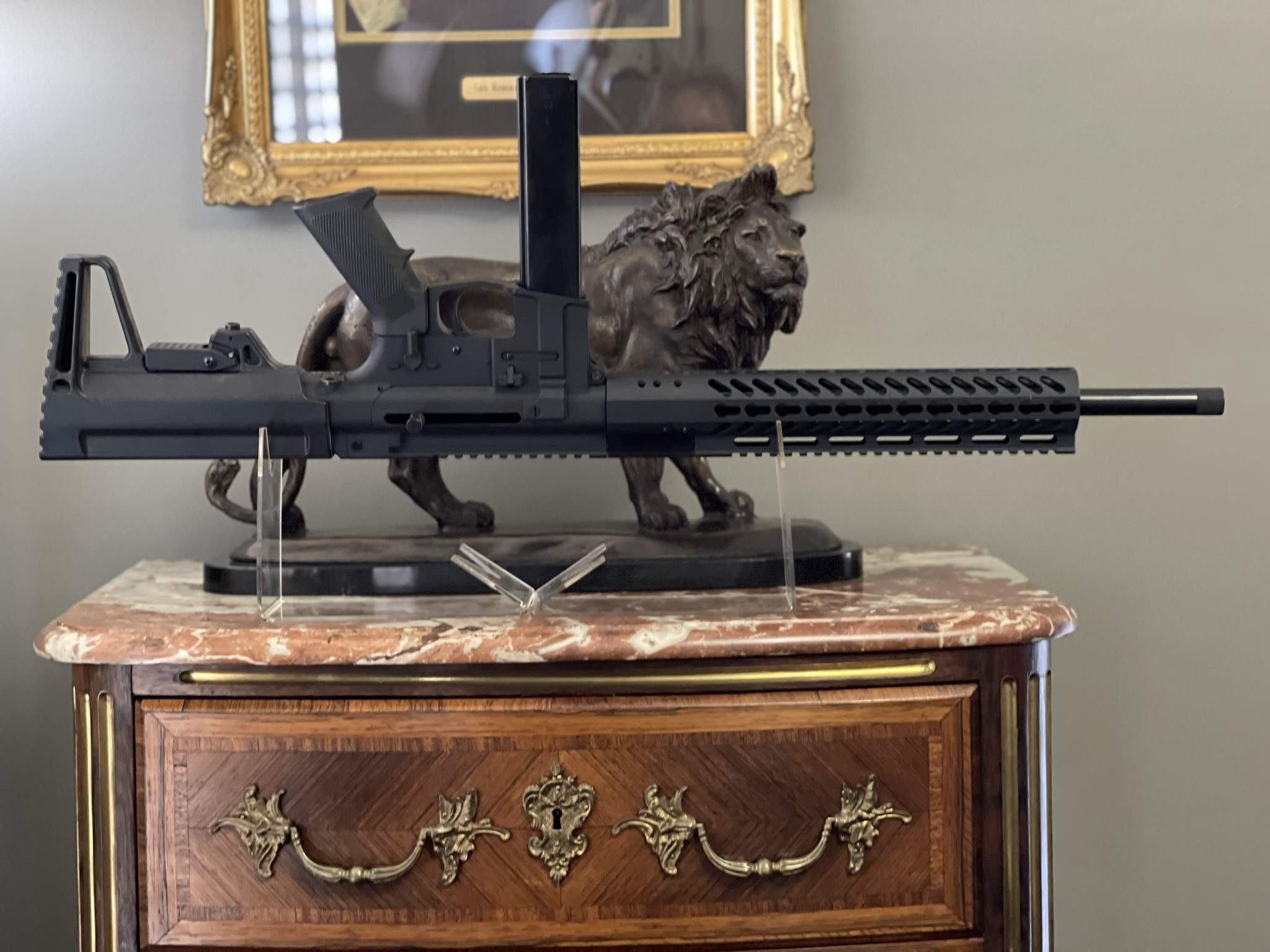
A carbine is best understood as a shortened long gun built around portability. It is generally shorter and lighter than a full-size rifle or musket, but still meant to be shouldered and aimed like a rifle.
For collectors, the term matters because it appears across several very different periods: cavalry arms, trapdoor and lever-action variants, World War II service arms, pistol-caliber shoulder arms, and compact versions of modern military rifles. A carbine is not a single mechanism. It is a role, a size class, and often a clue to how the arm was originally intended to be carried.
The collector question is not simply “is it short?” The better question is whether the short configuration was factory-made, military-issued, later altered, or marketed for a specific sporting or service role.
What Makes a Carbine Different?
Carbines usually trade some sight radius, barrel length, and sometimes velocity for easier carry and faster handling. Early users valued that shorter form because full-length rifles were awkward on horseback, in wagons, in dense brush, or in cramped service environments.
The carbine category includes muzzleloaders, breechloaders, lever actions, bolt actions, semi-automatics, and select-fire military arms. That variety is why collectors should avoid assuming that “carbine” always means one particular cartridge, action type, or era.
Historical Development
The word is closely associated with cavalry and mounted troops. In the black-powder era, a shorter shoulder arm was easier to carry with a saddle, sling, or scabbard. Early military carbines often sacrificed some range and power for portability.
As breechloading, metallic cartridges, and repeating actions matured, the carbine became more capable. The American Sharps carbine, Spencer carbine, Winchester lever-action carbines, and later military short rifles all reflected the same basic idea: make the shoulder arm compact enough for the job without giving up the advantage of a stocked firearm.
World War II and the M1 Carbine
World War II gave the carbine its most recognizable American example: the U.S. M1 Carbine. It was not simply a shortened M1 Garand. It was a separate lightweight semi-automatic arm chambered for the .30 Carbine cartridge and issued widely to troops who needed something handier than a full-size service rifle.
That distinction matters to collectors because the M1 Carbine developed its own production story, manufacturer variations, parts changes, stock features, and arsenal rebuild history. The name “carbine” describes the role, but the collector value lives in the details.
Identification and Markings
When evaluating any carbine, first determine whether the configuration is original. Look at barrel length, sights, stock inletting, sling hardware, proof marks, serial-number ranges, arsenal stamps, and whether the parts match the period of production.
| Feature | Collector Question |
|---|---|
| Barrel length | Is the barrel factory length, arsenal altered, or later cut down? |
| Stock and handguard | Do the wood, sling slots, bands, and finish match the expected pattern? |
| Markings | Are manufacturer, proof, import, or arsenal marks consistent with the claimed model? |
| Small parts | Do sights, bands, safeties, magazines, and hardware match the production period? |
| Documentation | Is there provenance, a factory letter, military paperwork, or credible reference support? |
Collector Insight
The most valuable carbines usually have the least guesswork.
A carbine with documented original configuration, correct markings, and unaltered parts will usually command more confidence than one that merely looks short, handy, and old.
Modern and Sporting Carbines
Modern usage broadened the term. The M4 Carbine, compact AK variants, pistol-caliber carbines, lever-action saddle-ring carbines, and lightweight hunting carbines all fit under the larger umbrella. For collectors, the important task is to place each example in its own context rather than forcing every carbine into one definition.
Pistol-caliber carbines are especially interesting because they connect modern range use with older ideas of shared ammunition, compact storage, and familiar handling. They may not have the same historical weight as a military carbine, but they still occupy a meaningful niche in a working collection.
Famous Military Carbines and Their Legacy
Some of the most collectible carbines in the world were designed specifically for military service. Their shorter length made them easier to carry in vehicles, on horseback, in airborne operations, and in confined battlefield conditions where a full-length rifle could become cumbersome.
American collectors immediately recognize the U.S. M1 Carbine, but many other important military carbines shaped firearms history. Winchester lever-action saddle ring carbines became symbols of the American frontier, while bolt-action carbines served cavalry and artillery units throughout Europe during the late nineteenth and early twentieth centuries.
The U.S. M1 Carbine remains one of the defining military firearms of World War II. Manufactured by companies including Inland, Winchester, IBM, Underwood, Rock-Ola, and National Postal Meter, the rifle developed an enormous collector following because of its wartime production variations and rebuild history.
Factory Variations and Collector Value
Factory-original carbines are usually worth significantly more than altered examples. Collectors should carefully study barrel length, sights, stocks, sling hardware, finish, proof marks, and serial-number ranges before assigning value.
One of the most common collector mistakes is confusing a cut-down rifle with a true factory carbine. Many surplus rifles were shortened after military service for hunting or utility use.
Common Collector Mistakes
- Calling any shortened rifle a carbine without checking whether the factory made that configuration.
- Ignoring stock alterations, replaced sights, or non-original barrel work.
- Assuming military rebuild marks are defects instead of part of the arm’s service history.
- Comparing carbines only by caliber instead of by originality, condition, and documentation.
Collector Takeaway
The carbine has remained popular because the concept is practical: a shoulder arm that is easier to carry and handle. The collector challenge is separating true factory or service carbines from later modifications. The shorter the gun, the more carefully the collector should study how it got that way.
Related Reading

About Greg Cook
Greg Cook writes about firearms collecting, personal history, and the stories behind interesting guns. His Army MOS was 76Y, Unit Armorer, and he brings that practical background to his collector articles.