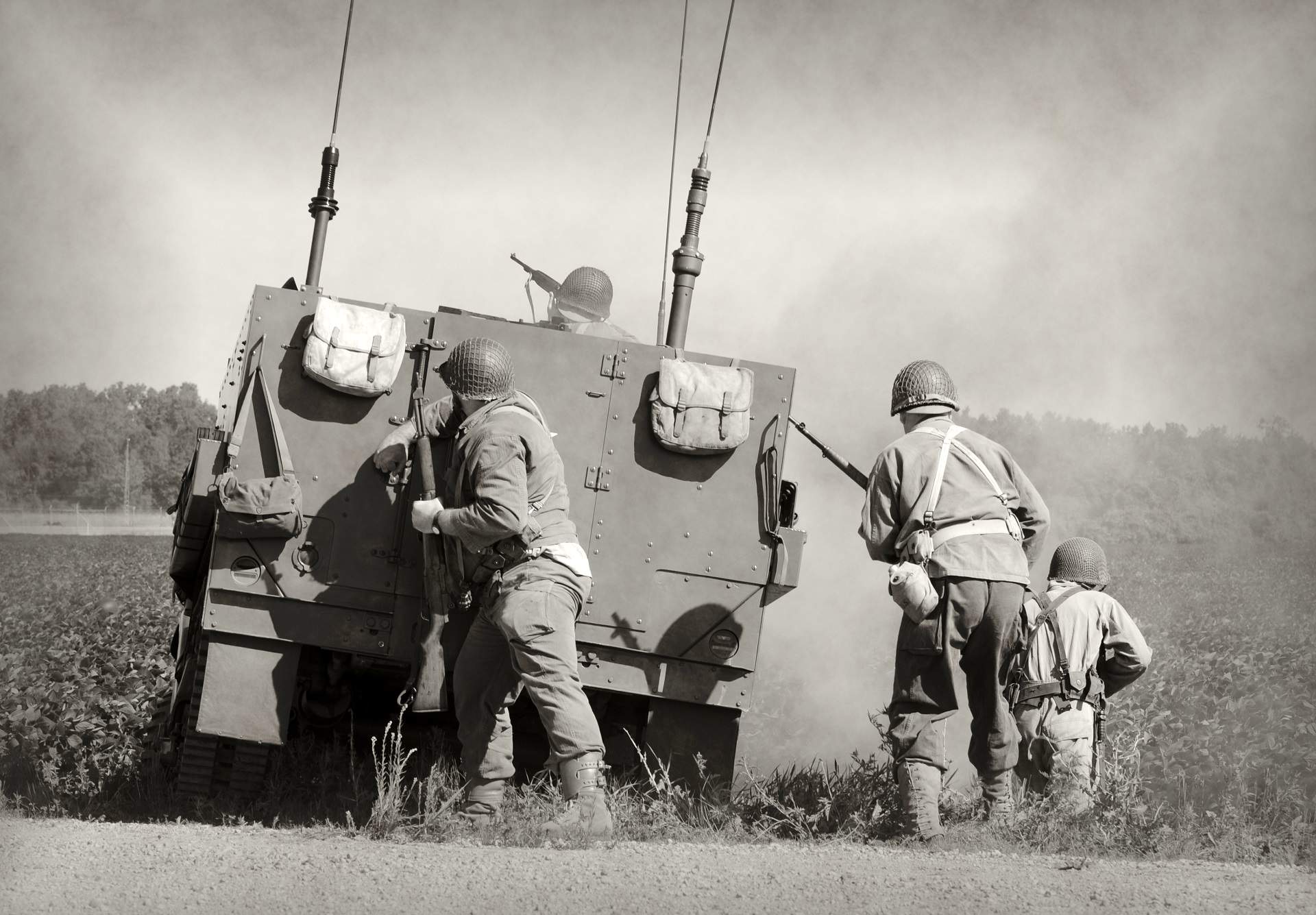
World War II Firearms belongs in the Gun Collectors Club Reference Library because it gives collectors historical context before they study individual models. Firearms are easier to understand when they are placed beside the conflicts, factories, design problems, and production eras that shaped them.
Collector value usually begins with context: what problem the firearm solved, who used it, and why the design mattered.
World War II and Industrial Firepower
World War II lasted from 1939 to 1945 and pushed firearm design, mass production, logistics, and battlefield specialization to a scale never seen before. The United States became a manufacturing arsenal for Allied victory.
Important World War II Firearms
Collector interest often centers on the M1 Garand, M1 Carbine, M1911 pistol, Thompson submachine gun, Browning M2 .50 caliber machine gun, Browning M1917A1, Springfield M1903A1, Winchester Model 70 sniper rifles, Winchester Model 1897, and wartime shotguns.
| Firearm | Why It Matters |
|---|---|
| M1 Garand | Standard U.S. semi-automatic service rifle. |
| M1 Carbine | Lightweight arm for support troops and mobile war. |
| Thompson | Iconic American submachine gun. |
| M2 Browning | Long-serving heavy machine gun platform. |
Production, Markings, and Surplus
World War II collecting often turns on arsenal markings, rebuild marks, manufacturer variations, serial-number ranges, cartouches, and whether a firearm remains in as-issued condition or was rebuilt after service.
Collector Perspective
World War II arms remain popular because they combine documented history, durable design, and broad availability. The challenge is separating original examples, arsenal rebuilds, postwar imports, and altered guns.
Collector Insight
World War II turned American factories into an arsenal at global scale.
Collectors are not just buying a firearm when they buy a WWII piece; they are buying evidence of production, logistics, wartime urgency, and the industrial system that supplied millions of soldiers.
Related Reading

About Greg Cook
Greg Cook writes about firearms collecting, personal history, and the stories behind interesting guns. His Army MOS was 76Y, Unit Armorer, and he brings that practical background to his collector articles.