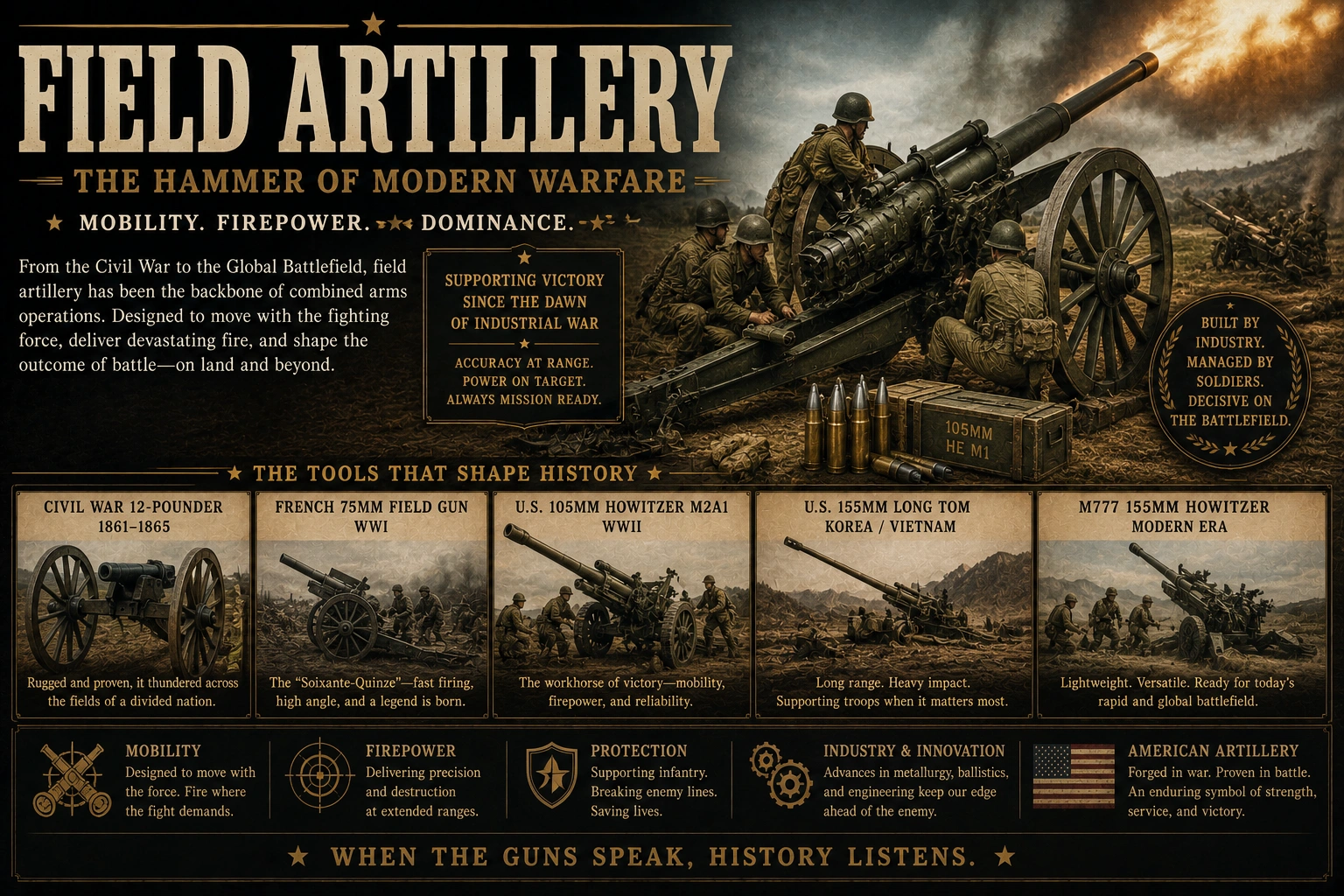
Field Artillery is part of the Gun Collectors Club American Firearms Encyclopedia. These entries connect mechanical design, historical use, production evolution, and collector evaluation into a single reference system.
This page is written as a practical collector reference: what the subject means, where it fits in firearms history, why it matters, and how it connects to other encyclopedia entries on the site.
When collectors understand the mechanism, the context, and the era, the firearm becomes more than an object — it becomes evidence.
Why Field Artillery Belongs in a Firearms Encyclopedia
Field artillery is not a shoulder arm, but it belongs in the American Firearms Encyclopedia because it explains the battlefield environment in which many collectible small arms were used.
Rifles, carbines, pistols, machine guns, and artillery were not isolated. They were part of a complete military system built around firepower, movement, logistics, and command.
Civil War Artillery and the Transition to Modern War
Civil War artillery included smoothbores, rifled guns, field pieces, and siege weapons. It worked alongside rifled muskets, cavalry carbines, and early repeaters. The period shows the transition from older battlefield methods toward industrial firepower.
World War I and World War II Artillery
World War I demonstrated the devastating power of artillery on an industrial scale. World War II made artillery mobile, coordinated, mechanized, and integrated with aircraft, armor, and infantry movement.
For collectors, understanding artillery helps explain trench warfare, machine-gun positions, infantry weapons, and why certain rifles and carbines were developed.
Collector Perspective
Most collectors will not collect artillery pieces, but they may collect shell casings, manuals, photographs, unit histories, trench art, inert ordnance, and battlefield artifacts. Those objects should be handled legally, safely, and with careful provenance.
Field Artillery and Firearms Collecting
Field artillery may seem far removed from the revolvers, rifles, and pistols that dominate most firearms collections, yet artillery shaped the battlefield environment in which many collectible military arms were developed and used. Understanding artillery history helps collectors better understand trench warfare, cavalry tactics, battlefield movement, defensive fortifications, and the industrial realities that drove firearms development during the nineteenth and twentieth centuries.
Collectors who study military firearms often discover that artillery history explains why certain rifles evolved the way they did. Long-range artillery forced armies to rethink mobility, entrenchment, communication, and infantry support. During World War I especially, artillery became one of the defining forces on the battlefield. The widespread use of trench systems, compact carbines, sidearms, and support weapons all reflected the changing realities of industrial firepower.
The collector overlap becomes even stronger when studying militaria. Artillery-related items such as shell casings, range equipment, spotting scopes, field telephones, manuals, trench art, and battlefield relics often appear alongside military firearms collections. These artifacts provide historical context that helps transform a firearm from a mechanical object into part of a larger historical story.
Many collectors also appreciate artillery history because it demonstrates the scale of industrial manufacturing during the World War era. Massive artillery production required advances in metallurgy, machining, logistics, and ammunition manufacturing that influenced the entire firearms industry. The same industrial systems that produced artillery pieces also produced rifles, machine guns, pistols, optics, and support equipment on an unprecedented scale.
Militaria and Historical Context
While relatively few collectors own actual artillery pieces, many pursue supporting artifacts connected to artillery units and battlefield operations. Unit photographs, shell fragments, inert training ordnance, ammunition crates, maps, and wartime manuals all contribute to historical interpretation. Provenance and documentation remain especially important in this category because battlefield relics are often separated from their original historical context over time.
Collectors should also exercise caution when dealing with ordnance-related artifacts. Legal requirements, inert verification, transportation rules, and safety considerations vary widely depending on the item involved. Historical interest should always be balanced with careful documentation, lawful ownership, and common-sense safety practices.
| Collector Question | Why It Matters |
|---|---|
| What conflict or era? | Civil War, WWI, WWII, and later artillery have different collector context. |
| Is the item inert and legal? | Ordnance-related collecting requires serious caution and legal awareness. |
| Does provenance exist? | Unit history, battlefield context, and documentation matter. |
| How does it relate to small arms? | Artillery explains much of the battlefield environment around collectible firearms. |
Encyclopedia Insight
Artillery explains why small arms changed.
The story of rifles and carbines is incomplete without artillery. Industrial firepower changed how soldiers moved, how trenches formed, why machine guns mattered, and why compact, reliable small arms became essential.
Related Encyclopedia Entries
Build Your Reference Shelf
Encyclopedia-style collecting works best with good books, careful photography, magnification, and a slow research process. I keep a curated list of reference books and collector tools for this kind of work.
Shop My LibraryAs an Amazon Associate I earn from qualifying purchases.

About Greg Cook
Greg Cook writes about firearms collecting, personal history, and the stories behind interesting guns. His Army MOS was 76Y, Unit Armorer, and he brings that practical background to his collector articles.